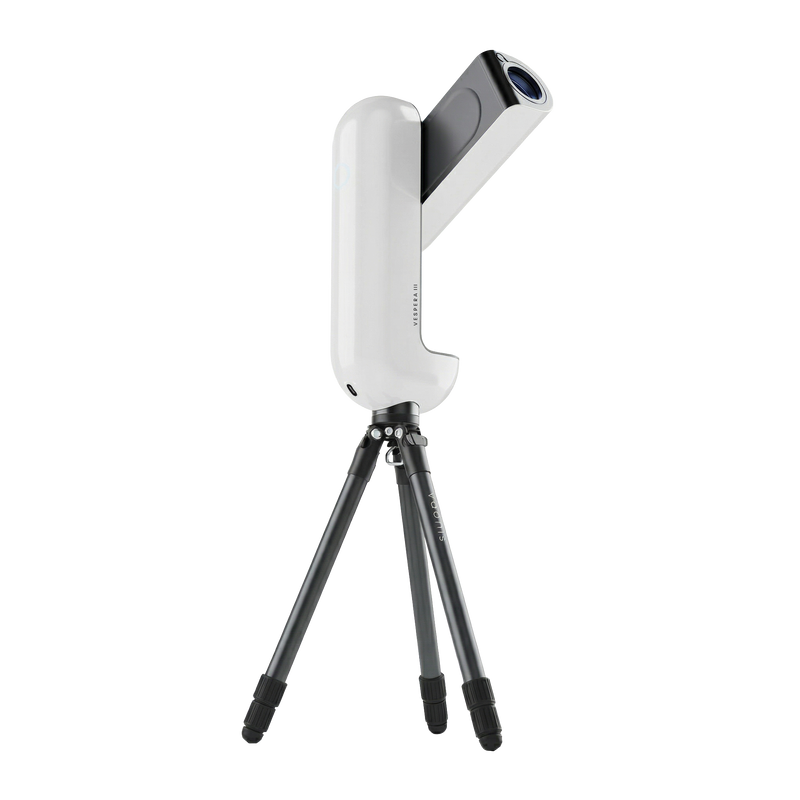
What is the main difference between the Vaonis Vespera III and the Vespera Pro II?
The primary difference is the imaging sensor and resulting field of view. The Vespera III has an 8.3 MP sensor with a wider 2.5° x 1.4° field of view, making it better for large targets. The Vespera Pro II has a 12.5 MP sensor with a narrower 1.6° x 1.6° field but higher detail resolution (1.7 arcsec/pixel vs 2.44), making it better for resolving fine detail in smaller objects. The Pro II also includes more storage (225 GB vs 115 GB) and a carbon fiber tripod.
How does the Vaonis Vespera III's 24 MP CovalENS mode work?
CovalENS is Vaonis's automated mosaic technology. When you select a target larger than the Vespera III's native 2.5° x 1.4° field, the telescope automatically captures multiple adjacent image panels and stitches them into a single, high-resolution 24 MP image. This allows you to capture vast objects like the Andromeda Galaxy (M31) or the North America Nebula (NGC 7000) in their entirety.
Can I use the Vespera III for imaging planets like Jupiter or Saturn?
The Vespera III is a wide-field instrument with a focal length of 245 mm, designed primarily for deep-sky objects like nebulae and galaxies. While you can see planets, it does not provide the high magnification needed for detailed planetary imaging. Its strength lies in its expansive field of view, not planetary resolution.
How effective is the Vespera III in a light-polluted city?
The Vespera III's live stacking improves the signal-to-noise ratio, which helps pull out detail from deep-sky objects even under bright skies. For best results in a city, using the optional CLS (City Light Suppression) filter is highly recommended to block artificial skyglow and improve contrast.
What image formats can I export from the Vespera III?
The Vespera III provides multiple export options. For easy sharing, you can save 8-bit JPEG files. For more serious image processing, you can access the stacked 16-bit TIFF files or the individual, unstacked 16-bit FITS frames from the 115 GB of internal storage. This gives you full control for post-processing in dedicated astronomy software.
How long does the Vespera III's battery last, and can I extend it?
The internal 10,000 mAh battery lasts for about 11 hours on a full charge. You can power and charge the telescope via its USB-C port using a compatible Power Delivery (PD) power bank, allowing you to run the instrument for even longer sessions.
Does the Vespera III require manual focusing?
No, the Vespera III features a fully automatic autofocus system. The telescope focuses automatically, ensuring your images remain sharp without any manual intervention.
What is the Multi-Night Capture feature on the Vespera III?
Multi-Night Capture allows you to image the same object over several different nights. The Vespera III saves your progress in one of 15 multi-night slots on its 115 GB internal drive. You can then resume the imaging session on a subsequent night to accumulate more exposure time and improve the final image quality.
How does the included hygrometer sensor prevent dew on the Vespera III?
The hygrometer sensor fits into the Vespera III and monitors the ambient temperature and humidity. When it detects that conditions are approaching the dew point, it automatically activates the telescope's integrated anti-fog system. This keeps the front lens clear of condensation, ensuring your imaging session is not interrupted by dew.
Can I observe the Sun with the Vaonis Vespera III?
Yes, but only with the optional Vaonis Solar Filter designed specifically for the Vespera III. You must never point the telescope at the Sun without this filter properly installed. The Singularity app has a dedicated solar observation mode that works in conjunction with the filter for safe viewing and imaging of sunspots.