Astrodon
Astrodon built its reputation on filters that are consistent — parfocal within tight tolerance, matched in transmission so that colour weighting is predictable, and coated so that halos around bright stars simply do not appear. For imagers who have eliminated every other variable, that consistency is what remains worth paying for. David Astro carries Astrodon products in Canada, stocked domestically and ready to ship.
These are precision components and specifying them well means matching bandwidth, size and mounting to your exact system. Tell us your camera, wheel and focal ratio.
Filtres
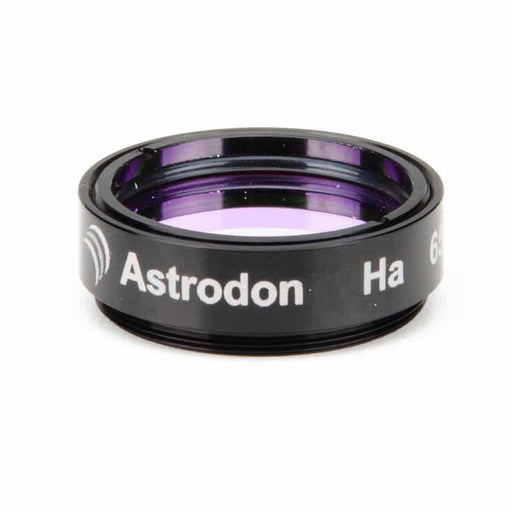
Astrodon Filtre H-alpha - 5nm
H-α (hydrogène-alpha) à 656 nm (nanomètres) est de couleur rouge foncé et le filtre à bande étroite le plus populaire. L'hydrogène est omniprésent...
Afficher tous les détailsAstrodon Filtre SII - 5nm
Si vous voulez l'apparence des images du télescope spatial Hubble (HST), comme les célèbres "Piliers de la Création" (la nébuleuse de l'Aigle, Mes...
Afficher tous les détailsThe Astrodon Filter Range
The catalogue divides between imaging filters for aesthetic astrophotography and photometric filters for measurement work, with different design priorities in each.
- Narrowband Ha, OIII and SII: Available in several bandwidths, with coatings engineered to suppress the halos that bright stars can produce in lesser filters.
- LRGB filter sets: Transmission curves balanced so that equal exposure times across channels give near-neutral star colour, which simplifies processing considerably.
- Parfocal matching: Filters within a set are matched in optical thickness so that refocusing between channels is minimal or unnecessary.
- Photometric filters: Sloan and Johnson-Cousins standard passbands for scientific measurement, where the transmission curve must match a published standard rather than look pleasing.
- Mounted and unmounted formats: Round mounted filters for standard wheels and unmounted squares for larger sensors where every millimetre of clear aperture counts.
- Sizes for large sensors: Formats sized to keep full-frame and larger chips free of filter-edge vignetting.
Why Choose David Astro for Astrodon
At this level of filter, the specification details are what separate a good result from a frustrating one.
- Size calculated against your geometry: Filter size depends on sensor diagonal and the distance from filter to sensor, and we calculate it rather than defaulting to a nominal match.
- Bandwidth matched to focal ratio: We recommend against the narrowest option in very fast systems where the passband shift would cost you signal.
- Focus offsets and spacing: We account for filter thickness in your back-focus calculation and help set per-filter focus offsets.
- Authorized dealer: Genuine Astrodon filters with verified coatings and full manufacturer warranty, in Canadian stock.
- Ships from Canada: No duties or brokerage fees for Canadian buyers on precision optics.
Astrodon in Canada — Frequently Asked Questions
- What causes halos around bright stars?
- Internal reflection between filter surfaces and the sensor window. Coating design and substrate quality determine how much appears, which is a large part of what separates filter tiers.
- Are parfocal filters really parfocal?
- Within a tolerance. Matched sets minimise refocus between channels, but at very fast focal ratios the critical focus zone is narrow enough that small per-filter offsets are still worth configuring.
- Do I need photometric filters?
- Only for measurement work — variable star photometry, exoplanet transits, supernova monitoring. For aesthetic imaging, LRGB sets are the right choice and considerably less expensive.
- Mounted or unmounted?
- Mounted for standard filter wheels and easier handling. Unmounted squares maximize clear aperture for large sensors, but require a wheel designed to hold them.
Specifying a filter set?
Send us your camera, wheel and focal ratio and we will size and select. Ships from Canada, full warranty.