
Passer au contenu

Langue

Pays

Filtres

A filter decides what light reaches your sensor or your eye, and under Canadian suburban skies that decision often matters more than aperture. The right narrowband filter can make a nebula imageable from a driveway that visually shows almost nothing. David Astro carries filters in Canada — narrowband, LRGB, light pollution, planetary, solar and scientific — in 1.25", 2", 31 mm, 36 mm and unmounted formats, shipped from Canadian stock.

Filter selection is where our team spends a lot of time, because bandwidth, f-ratio and sensor size interact in ways that are not obvious from a product page. Tell us your telescope and camera and we will recommend a set that works together.
Filtres

Prix d'origine CA$181.00 - Prix d'origine CA$349.00
Prix d'origine
CA$181.00 - CA$349.00
Prix actuel CA$181.00
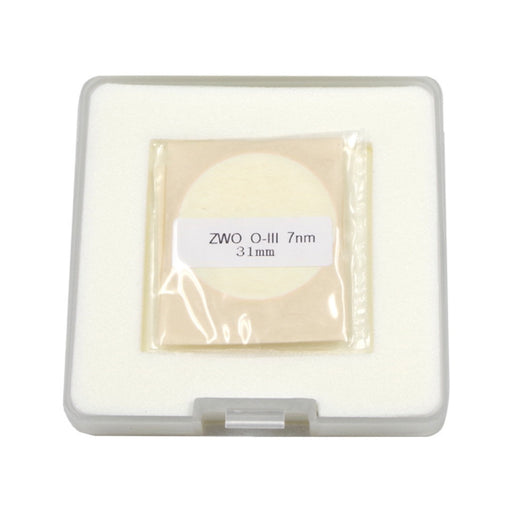
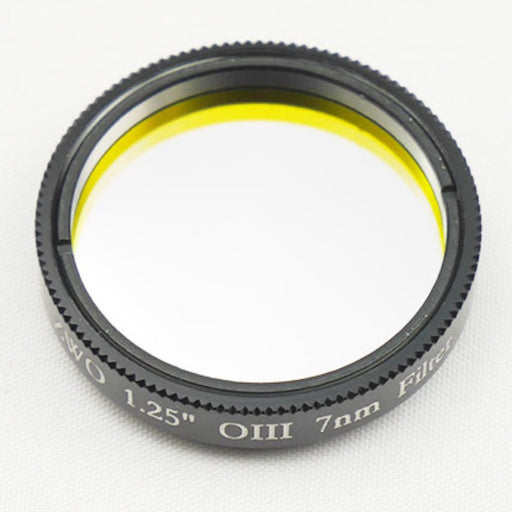
ZWO Filtre à bande étroite OIII - 7nm

Options available
1 variants in stock

Bande passante de 7nm centrée sur la raie d'émission OIII Isole les nébuleuses planétaires et les rémanents de supernova Cellule filetée standard ...

Afficher tous les détails
Prix d'origine CA$181.00 - Prix d'origine CA$349.00
Prix d'origine
CA$181.00 - CA$349.00
Prix actuel CA$181.00
Prix d'origine CA$181.00 - Prix d'origine CA$349.00
Prix d'origine
CA$181.00 - CA$349.00
Prix actuel CA$181.00

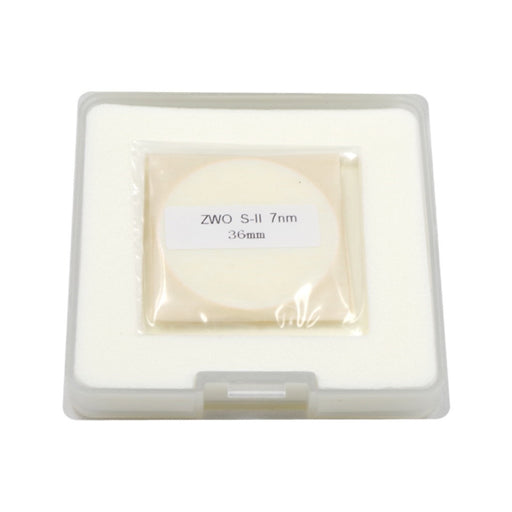
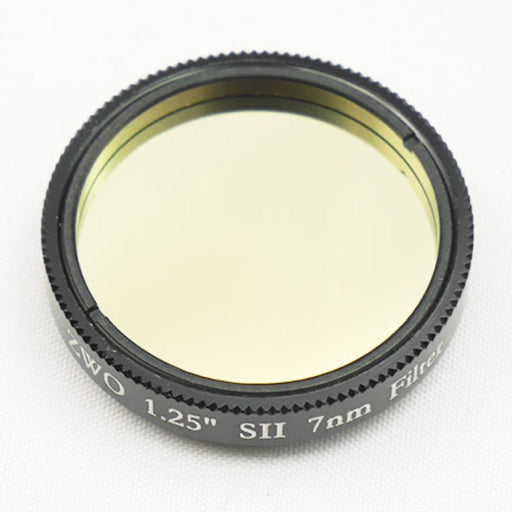
ZWO Filtre à bande étroite SII - 7nm

Options available
2 variants in stock

Isole la raie d'émission du soufre II à 672nm Bande passante de 7nm pour une imagerie à fort contraste Barillet métallique fileté standard 1.25" S...

Afficher tous les détails
Prix d'origine CA$181.00 - Prix d'origine CA$349.00
Prix d'origine
CA$181.00 - CA$349.00
Prix actuel CA$181.00
Prix d'origine CA$22.00 - Prix d'origine CA$22.00
Prix d'origine
CA$22.00
CA$22.00 - CA$22.00
Prix actuel CA$22.00
ZWO Adaptateur de filtre T2-1.25"

ZWO-T2-1.25-3
8 en stock

Relie les caméras à filetage M42 (T2) aux filtres 1.25" N'ajoute que 1 mm de longueur optique au train optique Préserve le backfocus critique des ...

Afficher tous les détails
Prix d'origine CA$22.00 - Prix d'origine CA$22.00
Prix d'origine
CA$22.00
CA$22.00 - CA$22.00
Prix actuel CA$22.00
Prix d'origine CA$40.00 - Prix d'origine CA$69.00
Prix d'origine
CA$40.00 - CA$69.00
CA$40.00 - CA$69.00
Prix actuel CA$40.00

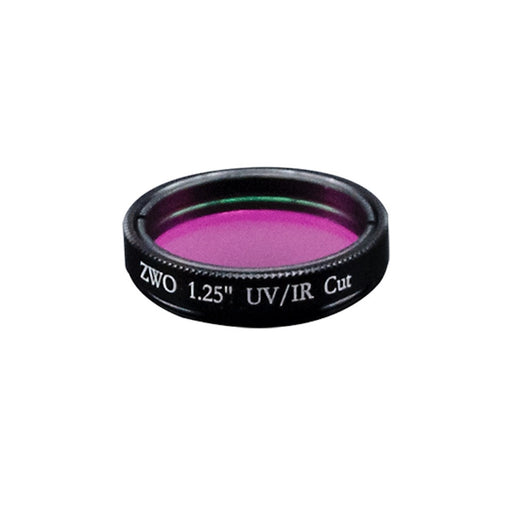
ZWO Filtre UV/IR CUT

Options available
40 variants in stock

Se visse dans les porte-filtres et coulants 1.25" standards Bloque les longueurs d'onde ultraviolettes (UV) et infrarouges (IR) indésirables Sert ...

Afficher tous les détails
Prix d'origine CA$40.00 - Prix d'origine CA$69.00
Prix d'origine
CA$40.00 - CA$69.00
CA$40.00 - CA$69.00
Prix actuel CA$40.00

Filter Types and When Each One Earns Its Place

Filters do not add signal. They remove unwanted light so that the signal you want has better contrast against the background. Choosing well means knowing which unwanted light you are fighting.

  • Narrowband filters: Ha, OIII and SII passbands, typically 3 to 12 nm. Narrower bands reject more light pollution and moonlight but demand accurate focus and longer exposures.
  • LRGB filter sets: Parfocal luminance, red, green and blue for colour imaging with monochrome sensors, with the luminance channel carrying most of the detail.
  • Light pollution filters: Broadband rejection of mercury and sodium emission lines. Effective against older street lighting and much less effective against broad-spectrum LED.
  • Planetary and colour filters: Wratten-standard colour filters that raise contrast on specific planetary features — a red or orange filter on Mars, blue on Jupiter's belts.
  • Solar filters: Full-aperture white-light filters for safe observation of sunspots and transits.
  • Neutral density and polarizing: Variable brightness reduction for lunar observing without altering colour balance.

Why Choose David Astro for Filters

A filter that performs beautifully at f/7 can produce a shifted passband and soft results at f/3. That is the kind of detail worth asking about before ordering.

  • F-ratio matched recommendations: Narrowband passbands shift blueward in fast optical systems, so we recommend filters specified for your focal ratio rather than the narrowest available.
  • Sensor size and vignetting: We size filters to your sensor diagonal and filter wheel placement, so an undersized filter does not clip your corners.
  • Spacing accounted for: Filter glass shifts focus by roughly a third of its thickness, and we include that in the back-focus calculation we provide.
  • Authorized dealer: Genuine filters with full manufacturer warranty and verified coatings, in Canadian inventory and shipped domestically.
  • Ships from Canada: No duties or brokerage charges for Canadian buyers.

Filters in Canada — Frequently Asked Questions

Do light pollution filters still work under LED streetlights?
Much less well than they did under sodium lighting. LED emits across a broad spectrum, so there is no narrow band to reject. Narrowband filters remain effective because they pass only emission lines regardless of what the streetlight does.
How narrow should my Ha filter be?
For f/5 and slower, 3 to 5 nm gives excellent contrast. Below about f/4, the incident light cone shifts the passband and a 6 to 7 nm filter, or one specified for fast optics, performs better.
What size filters do I need?
Match the sensor diagonal plus the distance from filter to sensor. A 36 mm filter typically covers APS-C in a standard wheel; full frame usually needs 50 mm square or unmounted 2 inch.
Are filters shipped from Canada?
Yes, in-stock filters are held in our Canadian warehouse and reach Canadian customers without customs handling.

Building a filter set?

Tell us your telescope, camera and sky conditions and we will recommend the right bandwidths and sizes. Canadian stock, fast domestic shipping.