Skip to content
IMPORTANT: Our store is located in Canada. All orders that include products manufactured outside of Canada or USA will be subject to tariffs and duties, regardless of the order value. US customers are responsible for all applicable duties and tariffs, and those will be billed by the carrier, except for the Lacerta upgrade kit, for which we collect them at checkout.

Language

Country

Daystar Quark Chromosphere Solar Filter

SKU DAY-DSZ4C
Original price $1,295.00 - Original price $1,295.00
Original price
$1,295.00
$1,295.00 - $1,295.00
Current price $1,295.00
Price Match Policy!
  • All-In-One Hydrogen-Alpha Solar Filter System
  • Designed for Chromosphere (Solar Surface) Detail
  • Integrated, H-Alpha Optimized Telecentric Barlow
  • Standard Eyepiece-Sized Form Factor
  • For Use with Refractor Telescopes
5 in stock
FREE Shipping in CONUS
  • Description
  • FAQ
  • Specifications
  • In the Box
  • Downloads
  • Warranty
  • Daystar Quark Chromosphere Solar Filter

    The Daystar Quark Chromosphere Solar Filter revolutionizes Hydrogen-Alpha observing by integrating a complete filter system into a single eyepiece-sized device. This all-in-one design combines a telecentric barlow, adapters, and a dedicated H-alpha filter, eliminating complex setups for use on a range of refractor telescopes. Optimized specifically for the Hydrogen-Alpha wavelength, the Quark Chromosphere is engineered to reveal high-contrast surface detail on the Sun, making dedicated solar observation more accessible than ever.

    Hydrogen-Alpha Observing in an Eyepiece Form Factor

    Daystar's Quark condenses an entire Hydrogen-Alpha filter assembly into a compact unit that drops into your diagonal just like an eyepiece. This fully integrated design eliminates the cost and complexity of sourcing separate barlows, adapters, and filter cells, streamlining your setup so you can start observing faster. Its lightweight, compact body reduces mechanical stress on your focuser and makes it an ideal companion for portable solar setups.

    Integrated Telecentric Optics for a Flat, Evenly Illuminated Field

    At the heart of the Quark is a custom telecentric barlow lens, fully optimized in its coatings and optical design for the Hydrogen-Alpha wavelength. This specialized component ensures the light rays passing through the Fabry-Perot etalon are parallel, delivering superior field flatness from edge to edge. To further improve views, internal baffles are added to increase contrast, and all coatings are optimized to maximize transmission at the critical H-alpha line.

    Tuned for High-Contrast Chromosphere Detail

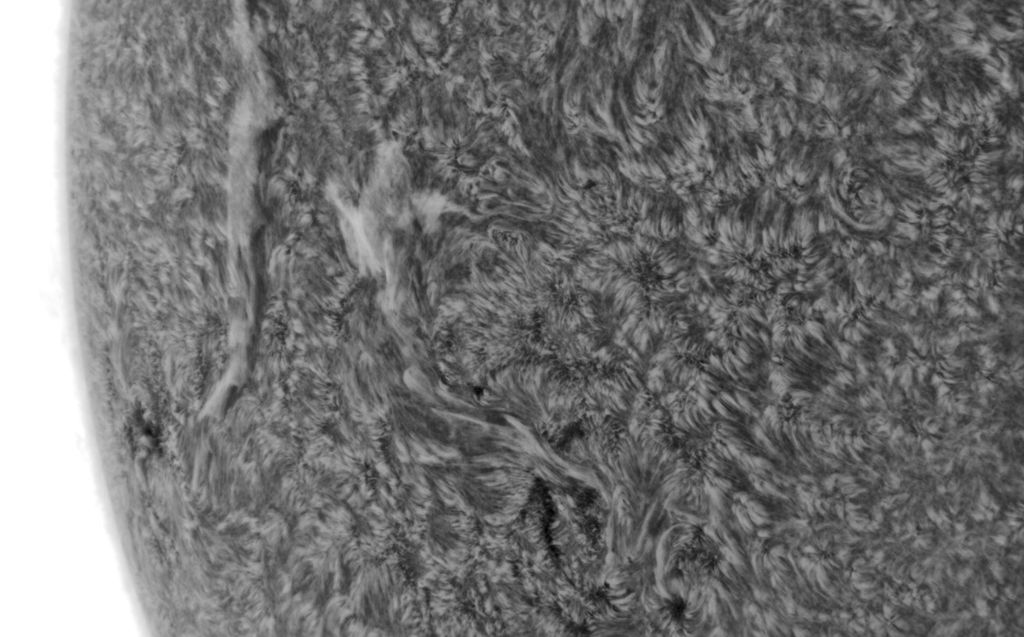
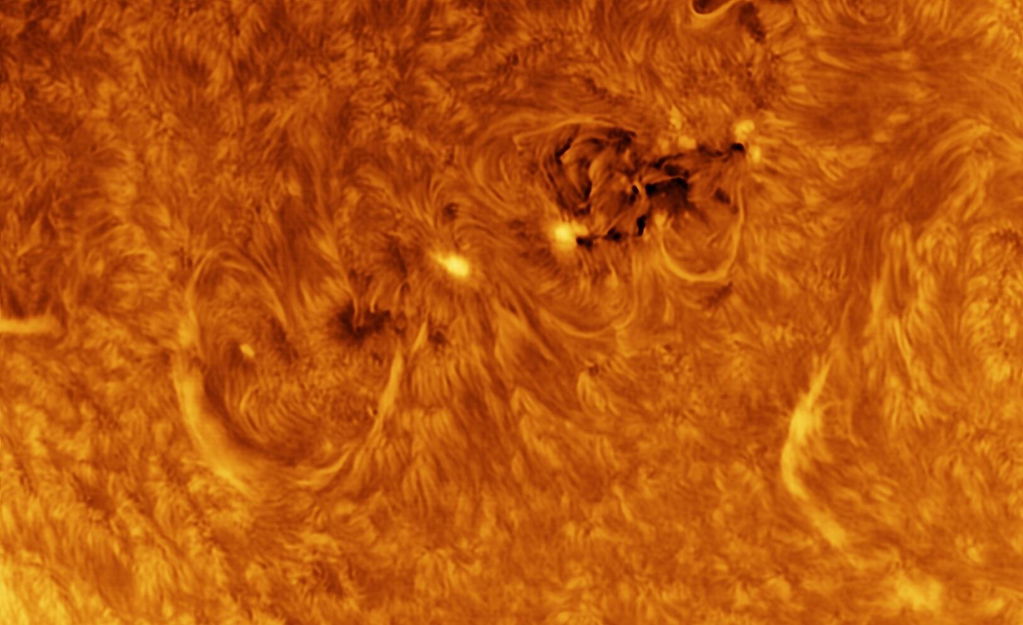
    This Quark model is specifically qualified to reveal the Sun's chromosphere, the turbulent layer of plasma just above the visible surface. It is tuned to maximize contrast on features like plages, filaments, and the intricate structure within and around sunspot groups. While it can still show prominences, its strength lies in making the complex, ever-changing solar disk stand out with sharp definition.

    Quark Chromosphere vs. Prominence: Choosing Your Target

    Daystar offers two versions of the Quark so observers can choose a filter based on their primary observing goals rather than budget.

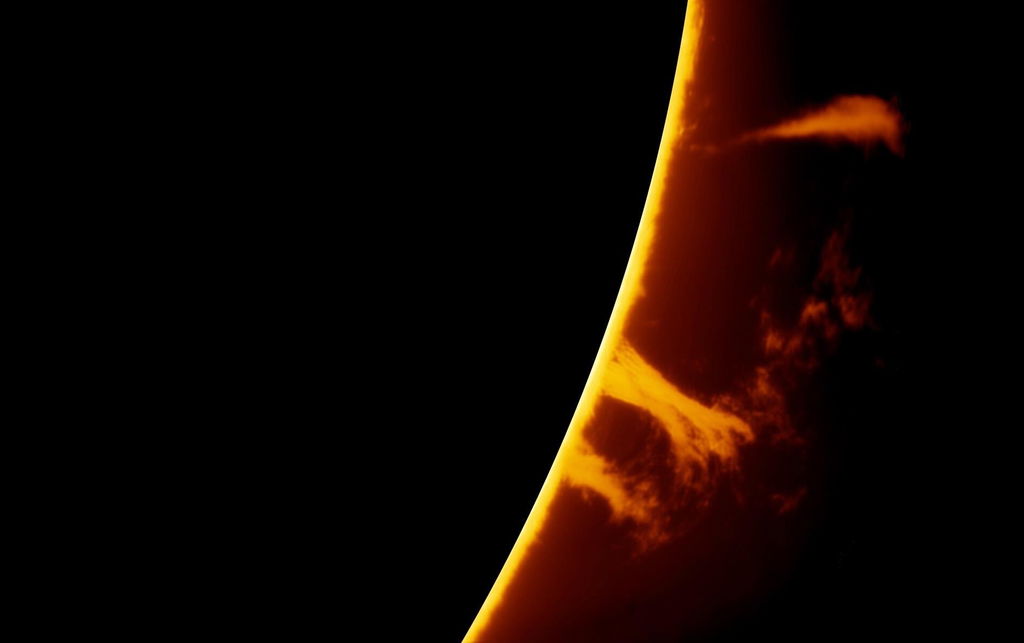
    • Prominence Model Advantage: The Prominence model is tuned to favor the faint, delicate structures erupting from the Sun's limb. It excels at capturing the detail in solar flares and large prominence loops against the blackness of space.
    • Chromosphere Model Advantage: This Chromosphere model provides higher contrast on the bright solar disk itself. If your primary interest is monitoring active regions, tracking filaments as they snake across the surface, or resolving granulation, this is the superior choice.
  • What kind of telescope works best with the Daystar Quark Chromosphere?

    The Quark Chromosphere is designed for use with refractor telescopes with focal ratios from f/4 to f/9. It is not suitable for use with Schmidt-Cassegrain or other reflector-style telescopes without significant, specialized adaptations and energy rejection components.

    Do I need other filters to use the Quark Chromosphere safely?

    Yes, potentially. For safety and best thermal stability, refractors with front apertures larger than 80mm require a front-mounted Energy Rejection Filter (ERF). For refractors 80mm or smaller, no front ERF is typically needed. Always confirm the specific requirements for your telescope before observing the Sun.

    Can I see solar flares with the Quark Chromosphere model?

    Yes, you can see prominences and flares with the Quark Chromosphere. However, it is specifically tuned to enhance contrast on the solar surface (chromosphere). For observers whose primary interest is capturing the faintest details in prominences against the dark sky, the Quark Prominence model is the recommended choice.

    How is the Daystar Quark Chromosphere powered?

    The Quark requires power to heat its internal etalon to the precise operating temperature. It is powered via a micro-USB port and can be run from a wall outlet or a small, portable USB battery pack for field use.

    Can I use the Daystar Quark Chromosphere for imaging?

    Absolutely. The Quark is an excellent tool for solar imaging. Simply attach a planetary or monochrome astronomy camera in place of an eyepiece to capture detailed images of the solar surface. Its flat-field telecentric optics provide sharp results across the camera sensor.

    What is the difference between a filament and a prominence seen with the Quark Chromosphere?

    They are the same physical structure viewed from different angles. When you see a cloud of gas erupting from the edge (limb) of the Sun, it's called a prominence because it's silhouetted against dark space. When that same structure rotates onto the bright solar disk, it appears as a dark, snake-like line called a filament. The Quark Chromosphere is optimized to show high contrast on these filaments.

  • Daystar Filters Warranty