
Skip to content
IMPORTANT: Our store is located in Canada. All orders that include products manufactured outside of Canada or USA will be subject to tariffs and duties, regardless of the order value. US customers are responsible for all applicable duties and tariffs, and those will be billed by the carrier, except for the Lacerta upgrade kit, for which we collect them at checkout.

Language

Country

Chroma

Chroma

Chroma filters are made for people who have already eliminated every other variable in their imaging and want the filter to stop being one. Hard-coated sputtered layers on high-quality substrates give very steep transitions, excellent blocking and — the characteristic imagers notice most — an absence of halos around bright stars. David Astro carries Chroma products in Canada, stocked in Canada and shipped worldwide.

These are premium components and worth specifying carefully. Tell us your camera, wheel and focal ratio and we will size and select precisely.

Filters

Original price $275.00 - Original price $830.00
Original price
$275.00 - $830.00
$275.00 - $830.00
Current price $275.00

Chroma SII Filter - 8nm

Options available

SII filters isolate the spectral emission of singly ionized sulfur atoms, also common in nebulae. Emission is at two lines occurring as a doublet, ...

View full details
Original price $275.00 - Original price $830.00
Original price
$275.00 - $830.00
$275.00 - $830.00
Current price $275.00
Original price $575.00 - Original price $1,550.00
Original price
$575.00 - $1,550.00
$575.00 - $1,550.00
Current price $575.00
Chroma SII Filter Optimized for f/3 - 3nm

Options available

SII filters isolate the spectral emission of singly ionized sulfur atoms, also common in nebulae. Emission is at two lines occurring as a doublet, ...

View full details
Original price $575.00 - Original price $1,550.00
Original price
$575.00 - $1,550.00
$575.00 - $1,550.00
Current price $575.00
Original price $275.00 - Original price $725.00
Original price
$275.00 - $725.00
$275.00 - $725.00
Current price $275.00

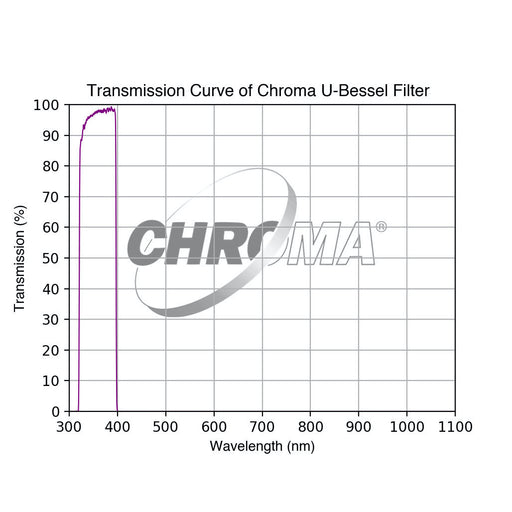
Chroma U-Bessel Filter

Options available

UV photometric filter in UVBRI series Filters designed for use with CCD and for f/4.0 or slower No reflections leading to image distortions or ""ba...

View full details
Original price $275.00 - Original price $725.00
Original price
$275.00 - $725.00
$275.00 - $725.00
Current price $275.00
Original price $1,175.00 - Original price $3,425.00
Original price
$1,175.00 - $3,425.00
$1,175.00 - $3,425.00
Current price $1,175.00
Chroma UBVRI Filter Set

Options available

UBVRI filter set for photometric imaging Filters designed for use with CCD and for f/4.0 or slower No reflections leading to image distortions or "...

View full details
Original price $1,175.00 - Original price $3,425.00
Original price
$1,175.00 - $3,425.00
$1,175.00 - $3,425.00
Current price $1,175.00
Original price $275.00 - Original price $725.00
Original price
$275.00 - $725.00
$275.00 - $725.00
Current price $275.00

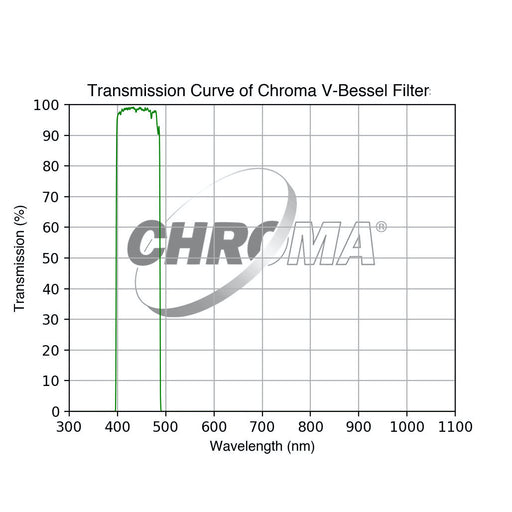
Chroma V-Bessel Filter

Options available

Green (Visible) photometric filter in UVBRI series Filters designed for use with CCD and for f/4.0 or slower No reflections leading to image distor...

View full details
Original price $275.00 - Original price $725.00
Original price
$275.00 - $725.00
$275.00 - $725.00
Current price $275.00

What Distinguishes Chroma Filters

The differences are in coating technology and substrate quality, and they show up in the parts of an image people spend the most time fixing in processing.

  • Hard-coated sputtered layers: Dense, durable coatings that do not degrade with humidity and give very steep band edges, so out-of-band light is rejected sharply.
  • Halo suppression: Substrate and coating design that minimizes internal reflection between the filter and the sensor window, which is what causes the rings around bright stars.
  • Narrowband Ha, OIII and SII: Several bandwidths, with the narrower options giving exceptional contrast in systems slower than about f/4.
  • LRGB sets: Balanced transmission across channels with tight parfocality, reducing both processing effort and per-filter focus offsets.
  • Substrate flatness: High optical flatness so the filter does not introduce wavefront error, which matters more as sensors and apertures grow.
  • Sizes for large sensors: Formats sized to keep full-frame and larger chips free of filter-edge vignetting.

Why Choose David Astro for Chroma

At this price level, specification errors are expensive, so we check them before you order.

  • Size calculated, not assumed: We compute the required filter size from your sensor diagonal and filter-to-sensor distance, so the corners stay clean.
  • Bandwidth matched to focal ratio: We advise against the narrowest bandwidth in very fast systems, where the passband shift would cost more signal than the contrast gains.
  • Spacing and offsets handled: Filter thickness is included in your back-focus calculation, and we help configure per-filter focus offsets.
  • Authorized dealer: Genuine Chroma filters with full manufacturer warranty and verified coatings, in Canadian stock.
  • Ships from Canada: No duties or brokerage fees for Canadian buyers.

Chroma in Canada — Frequently Asked Questions

Why do premium filters reduce halos?
Halos come from light reflecting between filter surfaces and the sensor window. Coating design, substrate quality and precise band placement all reduce that reflection, which is a large part of what you are paying for.
Is 3 nm always better than 5 nm?
Not in fast systems. Below roughly f/4, the steep light cone shifts a very narrow passband off the emission line and you lose signal. At f/5 and slower, 3 nm gives noticeably better contrast under light pollution.
Do hard coatings really last longer?
Sputtered hard coatings are dense and non-hygroscopic, so they resist humidity and cleaning far better than soft-coated filters, which can degrade over years of Canadian temperature and humidity cycling.
What size do I need?
It depends on sensor diagonal and how far the filter sits from the sensor, not on the sensor alone. Send us your camera and wheel and we will calculate it.

Upgrading your filters?

Send us your camera, wheel and focal ratio and we will specify precisely. Ships from Canada, full warranty.