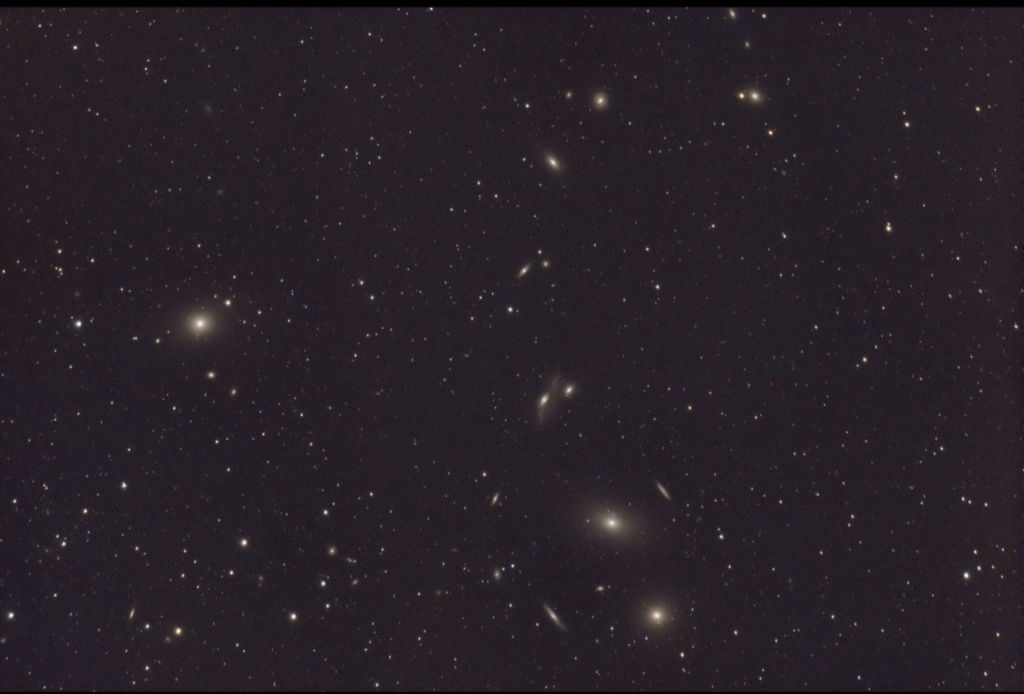
What are the main features of the ZWO ASI2600MC Pro?
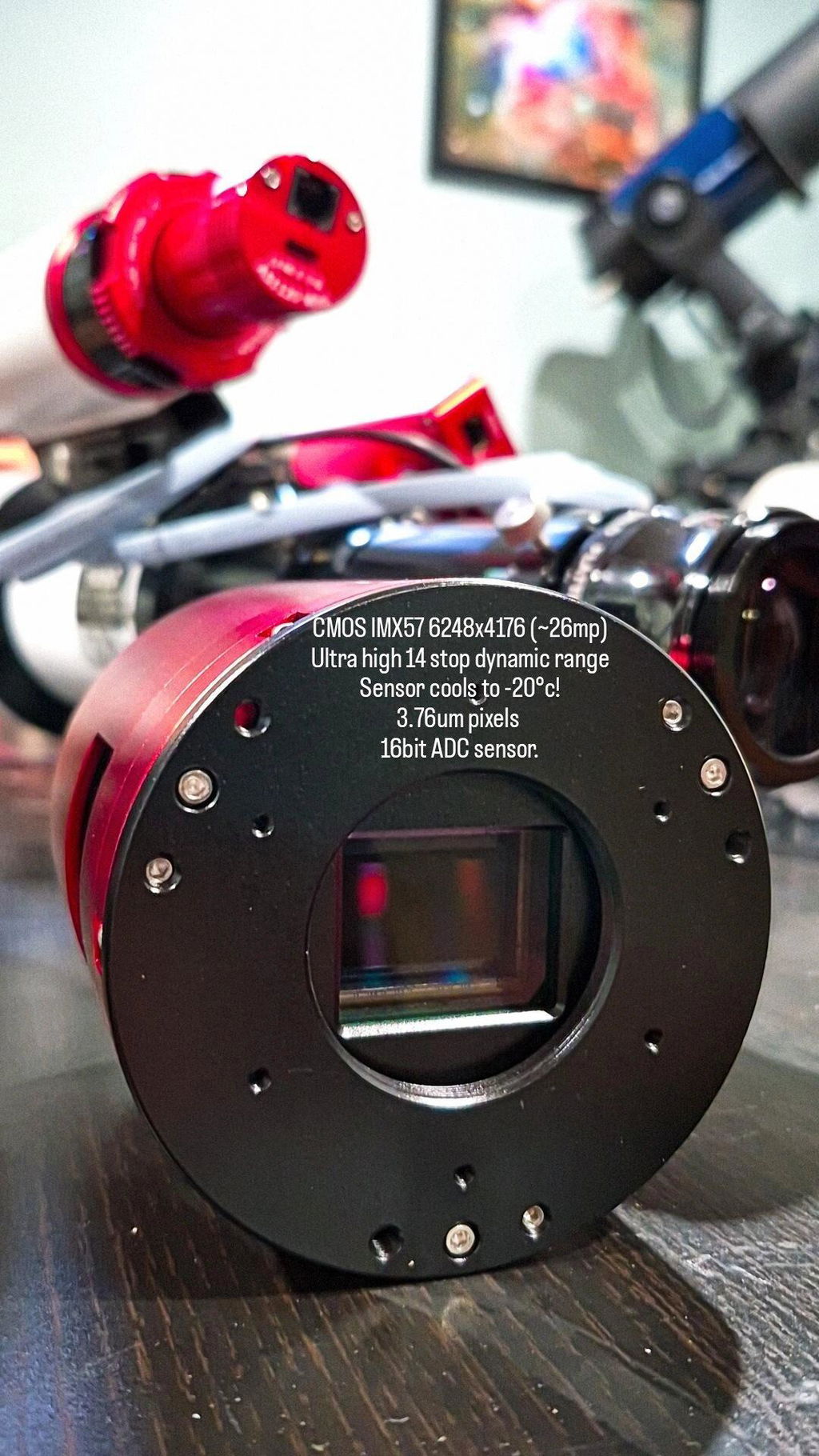
The ZWO ASI2600MC Pro combines three main features for deep-sky imaging: a large, high-resolution APS-C sensor (26.1 MP), two-stage TEC cooling (30-35°C below ambient) for low noise, and a 16-bit ADC with a 73ke full well for a 14-stop dynamic range. This combination allows you to capture clean, detailed, and vibrant images of faint nebulae and galaxies with simplified one-shot color acquisition.
How does the ASI2600MC Pro perform on a target like the North America Nebula (NGC 7000) with an f/5 refractor?
The camera's large 23.5mm x 15.7mm APS-C sensor suits large emission nebulae like NGC 7000. On an f/5 refractor of about 400mm focal length the field is about 3.4° x 2.2°, enough for the nebula and the adjacent Pelican Nebula (IC 5070) in one frame without a mosaic.
What are the power requirements for the ZWO ASI2600MC Pro?
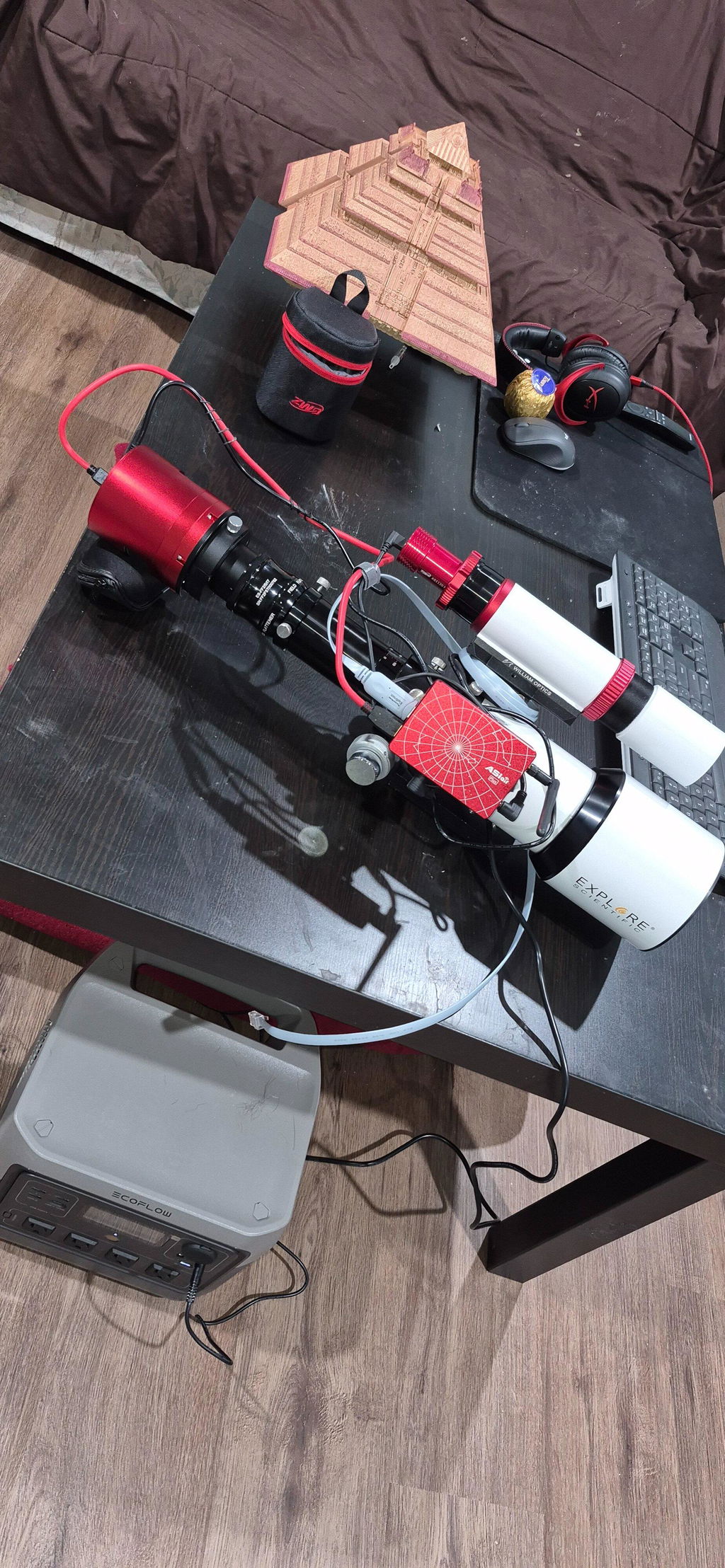
The ASI2600MC Pro needs an external 12V DC power supply rated 3A to 5A (or an 11-14V lithium battery) for its cooling system and anti-dew heater; external power supplies are needed for all ASI cooled cameras. A DC power port (5.5mm x 2.1mm, center positive) is located on the camera body. A power adapter is not included in the box.
Is the ZWO ASI2600MC Pro compatible with ASIAIR and third-party software?
Yes, the ASI2600MC Pro works with ZWO's ASIAIR devices for app-based control. It also works with third-party acquisition software on Windows, Linux and Mac OSX through ZWO's native, ASCOM or INDI drivers.
Is the 14.3 FPS of the ASI2600MC Pro fast enough for imaging Jupiter with an 8" SCT?
While you can image planets, the ASI2600MC Pro is not designed for high-resolution planetary work. Its large 26.1 MP sensor limits the full-frame rate to 14.3 FPS, which is too slow to effectively "freeze" atmospheric seeing, the technique used in modern planetary imaging. For targets like Jupiter, a dedicated planetary camera with a smaller sensor and frame rates over 100 FPS is better suited.
How do I achieve 55mm back focus with the ASI2600MC Pro?
The camera has a native back focus of 17.5mm. The box includes a 21mm M42 extender and a 16.5mm M42-M48 extender. By attaching these to the camera's M42 threads, you reach the standard 55mm back focus distance (17.5mm + 21mm + 16.5mm = 55mm) that many field flatteners and coma correctors use.
What is the benefit of the 'Zero Amp Glow' feature on the ASI2600MC Pro?
The ASI2600MC Pro has circuitry that eliminates amplifier glow, which is a common source of noise that appears as a bright gradient on the edge of long-exposure images from some CMOS sensors. This means your raw frames are cleaner and have a more uniform background, making calibration with dark frames simpler and more effective.
Should I use a gain of 0 or 100 for deep-sky imaging with the ASI2600MC Pro?
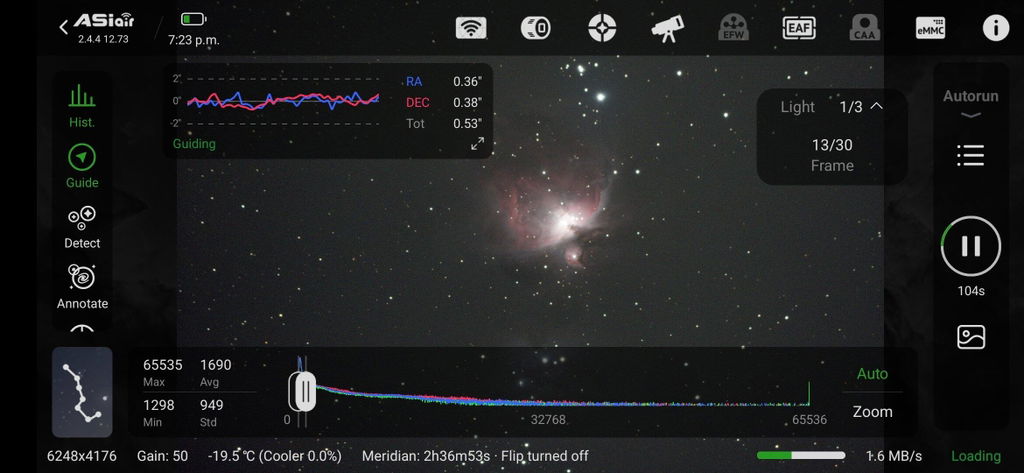
Use either gain 0 or gain 100. At gain 0, you utilize the camera's full dynamic range, which suits targets with bright stars or cores. At gain 100, the High Conversion Gain (HCG) mode activates, which significantly lowers read noise. It suits faint targets and shorter sub-exposures.
Does the ASI2600MC Pro require an IR Cut filter?
No. The ZWO ASI2600MC Pro has a built-in IR Cut filter that serves as its protective window. This filter blocks infrared light, which is important for color fidelity, especially when using refractive telescopes that may not focus IR light at the same point as visible light. You do not need to add a separate UV/IR cut filter to your imaging train.
What is the purpose of the 512MB DDR3 buffer in the ASI2600MC Pro?
The 512MB DDR3 buffer holds image data inside the camera; it minimizes data loss and latency, for stable transmission during long exposures and continuous high-resolution capture.