What kind of telescope works best with the Daystar Quark Chromosphere?
The Daystar Quark Chromosphere is specifically designed for refractor telescopes with focal ratios from f/4 to f/9. It is not suited for off-axis (SCT or Dobsonian) application. The Quark performs best in refractors from f/4 to f/8.
Do I need an energy rejection filter (ERF) to use the Quark Chromosphere?
It depends on your telescope's aperture. An ERF is recommended for any refractor with an aperture of 80mm or larger, or when tracking the Sun for long periods. This can be a UV/IR cut filter mounted before the diagonal or a full aperture red or yellow glass ERF in front of the telescope. For brief sessions with less than 80mm of aperture when not using a tracking mount, it can be OK to use no energy rejection at all, while staying alert for any rise in temperature.
Can I see the full solar disk with the Quark Chromosphere in my 102mm f/7 refractor?
No, you will see a magnified view of a portion of the Sun. The Daystar Quark Chromosphere provides a full-disk view only in telescopes with a focal length of approximately 450mm or less. Your 102mm f/7 refractor has a focal length of 714mm (102 * 7), which is too long to frame the entire Sun. It will give higher-magnification views of active regions and other surface details. At 102mm, an Energy Rejection Filter is recommended.
What is the difference between the Quark Chromosphere and Prominence models?
They are tuned for different primary targets.
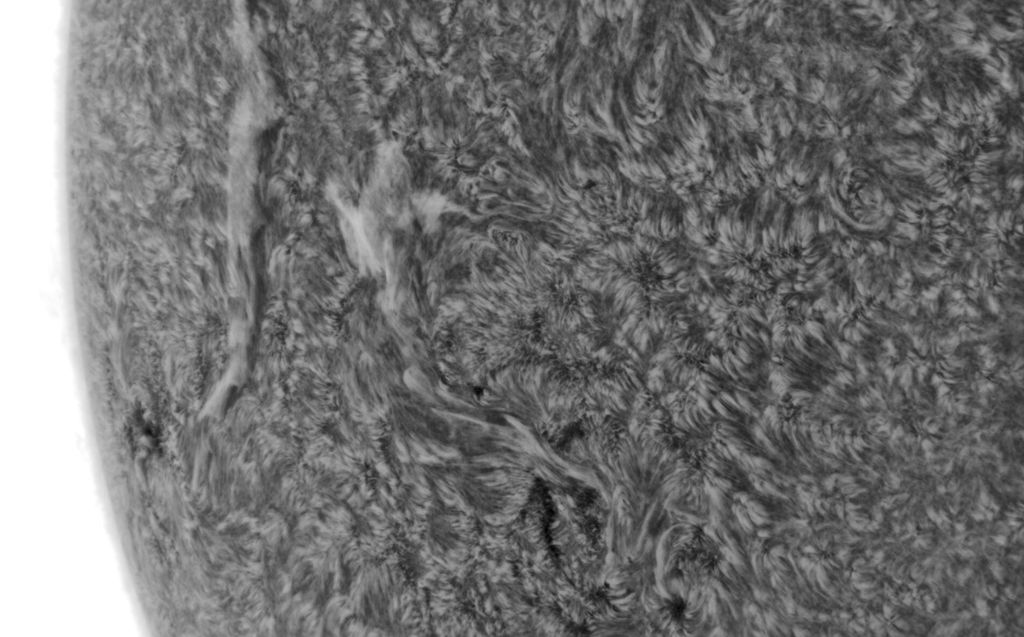
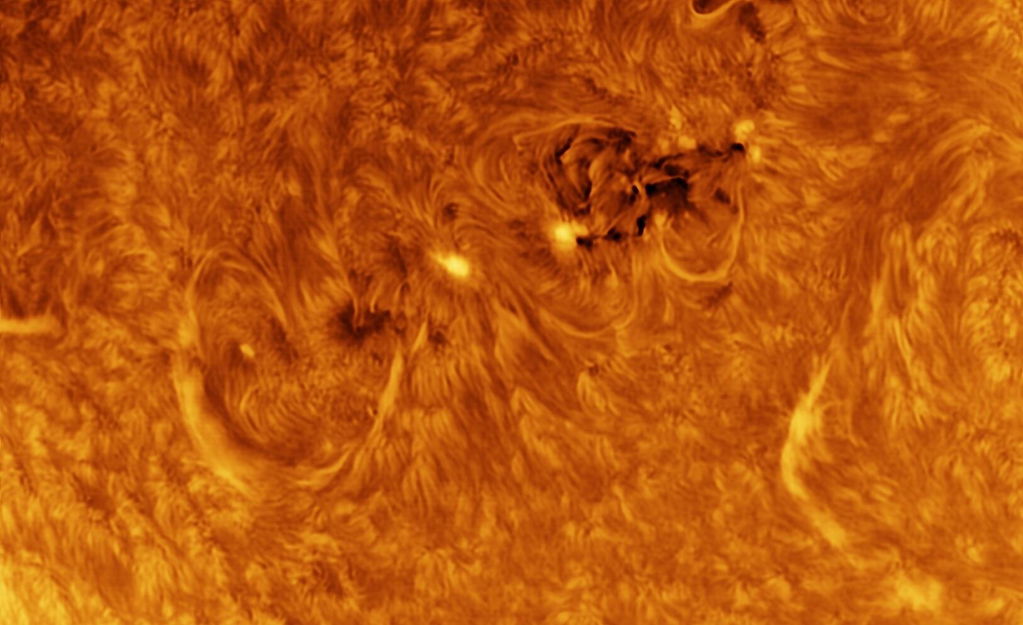
- The Quark Chromosphere (this model) has a narrower bandpass (generally 0.5Å or below) for higher contrast on the Sun's surface, making it ideal for viewing filaments and plage.
- The Quark Prominence model has a wider bandpass (generally 0.6Å or above) for a brighter image of prominences.
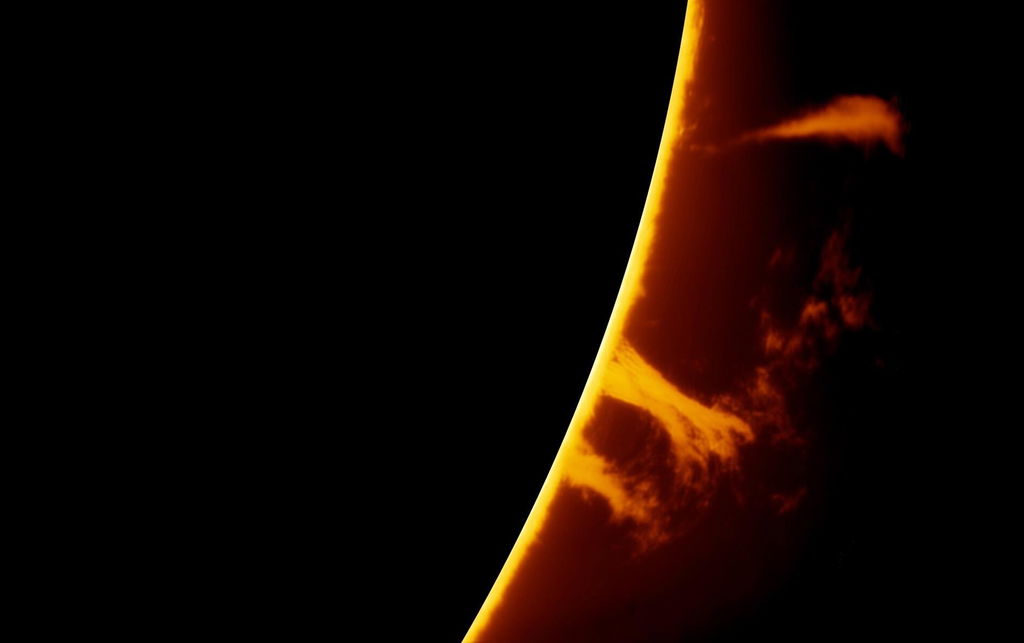
Daystar says both versions show prominences, but filaments are only visible in the Chromosphere version.
How is the Daystar Quark Chromosphere powered in the field?
The Quark requires a USB 5V, 1.5A power source. While it comes with a wall adapter, for field use you can power it with any portable USB power bank that can supply at least 1.5 amps. An optional 8-hour battery pack is also available from Daystar. A standard computer USB port will not work.
Why does the Quark Chromosphere take 5-6 minutes to warm up?
The internal Fabry-Perot etalon must be heated to a precise temperature to be tuned exactly to the 6562.8 Å Hydrogen-Alpha wavelength. The 5-6 minute settling time allows the internal heater and control electronics to bring the etalon to its stable operating temperature. The LED indicator turns from yellow to green when it's ready.
Can I use my high-power planetary eyepieces with the Daystar Quark?
No, it is not recommended. The Quark has an integrated 4.3x barlow, which already creates a very long effective focal length. At long focal ratios a high-powered eyepiece can exceed Dawes' limit and give a fuzzy disk without the ability to focus well. Plössl eyepieces of 25mm, 32mm, or 40mm give the best results.
What is the purpose of the ±0.5Å tuning knob on the Quark Chromosphere?
The tuning knob shifts the filter's center wavelength by up to 0.5Å either way in 0.1Å steps. A feature moving towards you will be brighter in blue (counter-clockwise) wing shift, and one moving away will be reddened (clockwise). If the image lacks contrast, try adjusting the center wavelength.
Can I use the Daystar Quark Chromosphere for imaging?
Yes. You can attach a monochrome astronomy camera to the 1.25" eyepiece holder to capture high-resolution images. Because of the long focal length, you will get highly magnified images. For a wider field of view with smaller camera sensors, optional focal reducers can be used.
How do I store the Quark Chromosphere filter when not in use?
The Daystar Quark Chromosphere should be stored with its end caps on in the included Twist-Case. For maximum longevity of the filter components, store it in a climate-controlled environment. Proper storage can extend the filter's life expectancy significantly.