
UV/IR, Clear & Specialty Filters
These are the quiet workhorse filters of astrophotography. A UV/IR cut filter stops ultraviolet and infrared light that most refractors cannot focus with visible light, so stars stay tight. An IR pass filter does the opposite, letting only infrared through to cut atmospheric turbulence on the Moon and planets. Clear filters and protective windows keep dust off the sensor and preserve focus position when you swap filters.
We carry UV/IR cut, IR pass (685 and 850 nm), UV pass, clear, fringe-killer and DSLR conversion filters from Baader, ZWO, Player One, Optolong, Antlia, Chroma, SVBONY and Daystar.
Original price
CA$62.00
-
Original price
CA$91.00
Original price
CA$62.00
-
CA$91.00
CA$62.00
-
CA$91.00
Current price
CA$62.00
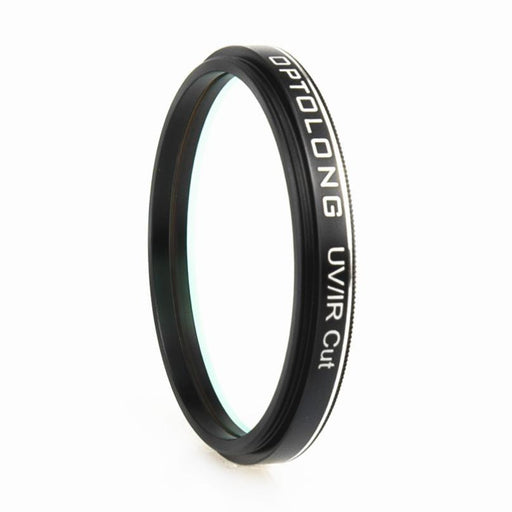
Optolong UV/IR Cut Filter
Blocks Ultraviolet (UV) and Infrared (IR) wavelengths Improves image sharpness and reduces star bloat Functions as a luminance (L) filter for mono...
View full details
Original price
CA$62.00
-
Original price
CA$91.00
Original price
CA$62.00
-
CA$91.00
CA$62.00
-
CA$91.00
Current price
CA$62.00


Original price
CA$34.00
-
Original price
CA$42.00
Original price
CA$34.00
-
CA$42.00
CA$34.00
-
CA$42.00
Current price
CA$34.00
Optolong Clear Focusing Filter
Achieve Critical Focus with Dim Stars Transmission >98.5% Across the Visible Spectrum λ/4 Transmitted Wavefront for Image Integrity 1.85mm B270...
View full details
Original price
CA$34.00
-
Original price
CA$42.00
Original price
CA$34.00
-
CA$42.00
CA$34.00
-
CA$42.00
Current price
CA$34.00


Original price
CA$111.00
-
Original price
CA$167.00
Original price
CA$111.00
-
CA$167.00
CA$111.00
-
CA$167.00
Current price
CA$111.00
Optolong Night Sky H-Alpha IR Pass Filter
Passes Infrared Light >650nm Blocks Visible Light from 300-570nm Average Transmission >90% 1.85mm Thick Optical Glass Substrate λ/4 Transmit...
View full details
Original price
CA$111.00
-
Original price
CA$167.00
Original price
CA$111.00
-
CA$167.00
CA$111.00
-
CA$167.00
Current price
CA$111.00

Original price
CA$110.00
-
Original price
CA$161.00
Original price
CA$110.00
-
CA$161.00
CA$110.00
-
CA$161.00
Current price
CA$110.00
Optolong IR Pass 685nm Planetary Filter
Passes infrared light above 685nm Achieves greater than 90% average transmission Blocks wavelengths from 350-1050nm outside the passband 1.85mm th...
View full details
Original price
CA$110.00
-
Original price
CA$161.00
Original price
CA$110.00
-
CA$161.00
CA$110.00
-
CA$161.00
Current price
CA$110.00