Skip to content

Language

Country

Sky-Watcher Classic 150P

SKU SW-S11600
Save 14% Save 14%
Original price CA$720.00
Original price CA$720.00 - Original price CA$720.00
Original price CA$720.00
Current price CA$620.00
CA$620.00 - CA$620.00
Current price CA$620.00
Price Match Policy!
  • 153 mm (6 in) Newtonian Reflector
  • 1200mm Focal Length (f/7.8)
  • Parabolic Borosilicate Primary Mirror
  • 20 mm and 12.5 mm Eyepieces Included
  • Patented Tension Control Handle for Altitude Adjustment
  • 2-inch Focuser with 1.25-inch Adapter
  • 6x30 Optical Finderscope
Backordered
Availability Info
Flat Rate Oversize Shipping
Visual Simulator
Visual SimulatorInstant FOV Preview

Preview your eyepiece's FOV

See exactly what the Sky-Watcher Classic 150P shows you, on real sky survey data.

Launch Visual Assistant
  • Description
  • FAQ
  • Specifications
  • In the Box
  • Downloads
  • Warranty
  • Sky-Watcher Classic 150P Dobsonian Telescope

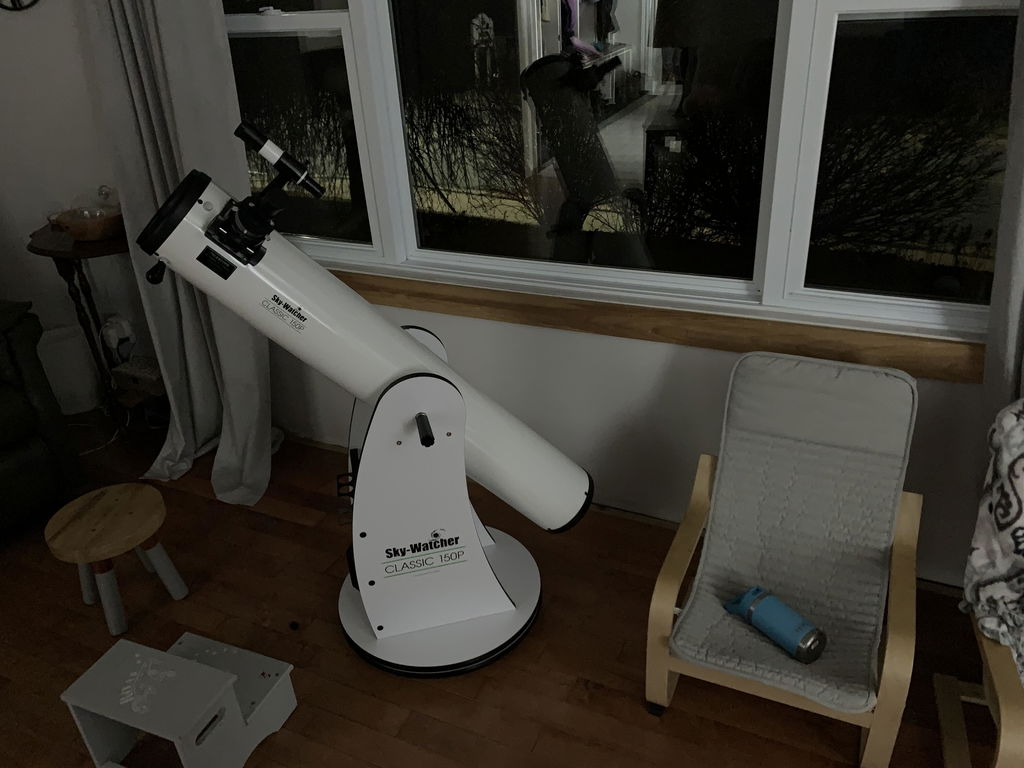
    The Sky-Watcher Classic 150P is a 6-inch Dobsonian featuring a 153 mm parabolic primary mirror with a 1200mm focal length (f/7.8). It comes with a Dobsonian base with Sky-Watcher's tension control handle, a 2-inch focuser with a 1.25-inch adapter, and two eyepieces that provide 60x and 96x magnification right out of the box. The optical tube weighs 5.78 kg (12.7 lb).

    The Classic 150P: A 153mm Dobsonian for Visual Astronomy

    John Dobson popularized this simple alt-azimuth mount for Newtonian reflectors in the late 1970s. In its simplest form it is a box that lets the tube pivot in altitude, while the box swivels on a base in azimuth.

    It is a good choice for first-time buyers. You point the telescope by hand. You swivel the tube in azimuth (left and right) and tilt it in altitude (up and down) to navigate the night sky. Because the Earth rotates, you nudge the tube in both axes to keep an object in the field.

    153mm Paraboloidal Optics and f/7.8 Focal Ratio

    At the core of the Classic 150P is its 153 mm paraboloidal primary mirror. Sky-Watcher uses a paraboloidal primary mirror to eliminate spherical aberration.

    The 1200mm focal length gives f/7.8. The 34mm secondary mirror sits on a four-arm bracket with fine 0.5 mm supports, which reduce diffraction spikes and light loss.

    60x and 96x Magnification with Included Eyepieces

    Magnification is the telescope's focal length divided by the eyepiece focal length. The two included 1.25-inch eyepieces give:

    • 20 mm eyepiece: 1200 / 20 = 60x.
    • 12.5 mm eyepiece: 1200 / 12.5 = 96x.

    A general rule for usable magnification is about 2x per millimeter of aperture under good seeing conditions. The highest practical power is 306x. Start at a lower magnification with its wider field, then increase it once you have found your target. An optional Barlow lens goes between the focuser and the eyepiece.

    The Dobsonian Base and Patented Tension Control Handle

    A traditional Dobsonian mount relies on friction to hold the optical tube in position. Too much friction makes it difficult to move the telescope smoothly, while too little allows the tube to drift, especially when changing heavy eyepieces. Sky-Watcher's answer is its patented tension control handle.

    It adds or reduces friction between the tube and the side board, so the tube does not need to be balanced to stay in position. Set it so the tube moves easily when nudged but stays put when you let go, or tighten it fully to lock it. Re-adjust it when you add or remove accessories. The manual recommends installing the tension handle on the same side as the focuser for convenience and leaving the handle on the opposite side slightly loose to give the tension handle full control.

    The 44.5-inch Optical Tube and Included Accessories

    The optical tube is 44.5 inches long with a 7.125-inch outer diameter. It comes with:

    • 2-inch Focuser: A 2-inch focuser with a 2" to 1.25" adapter, allowing you to use both the included 1.25-inch eyepieces and larger 2-inch wide-field eyepieces (sold separately).
    • 6x30 Finderscope: To help you locate celestial objects, a 6x30 optical finderscope is included. This small, fixed-magnification scope offers a much wider field of view than the main telescope. Once aligned, an object centered on its crosshairs is in the main eyepiece.
    • Dust Cap: Covers the tube when not in use; remove it before viewing.

    Assembling the 5.78 kg OTA and Dobsonian Base

    Assemble the telescope in daylight in a large, open area. The Dobsonian base arrives flat-packed and is assembled using the included screws and hardware. The process involves connecting the side boards (A1, A2) to board B, with the Sky-Watcher logos outside, then attaching this assembly to the round top board (C). A Teflon pad and a central tube are placed between this assembly and the bottom board (D), and a central bolt secures everything together. Do not over-tighten this bolt, so the base can swivel freely.

    Once the base is built, four cylindrical saddle side bearings are attached to the inside of the sideboards. The 5.78 kg optical tube assembly then rests on these bearings. The tension control handle is installed on the focuser side, and an accessory tray mounts to the front board. Screw caps cover the visible screws. Finally, move the rubber O-ring from the finder bracket to the groove on the finder tube and slide the bracket into its slot.

    Aligning the 6x30 Finder and Focusing Your View

    Before you can easily find objects, you must align the 6x30 finderscope with the main telescope. This is best done in daylight. Point the main telescope at a distant, stationary object at least 500 yards away and center it in the eyepiece. Then, look through the finderscope. Using the two small alignment screws on the finder bracket, adjust the finder until its crosshairs are also centered on the exact same object. These screws work against a spring-loaded knob.

    Once the finder is aligned, achieving focus is done by turning the focus knobs on the focuser. Slowly turn the knobs until the image in the eyepiece is sharp. Refocus when you change an eyepiece or add or remove a Barlow lens. The manual adds that fine refocusing over time is normal, due to temperature changes and flexure, especially before the telescope reaches outside temperature.

    Best Practices for Observing with the 153mm Aperture

    The manual's observing tips:

    • Site Selection: Away from city lights and upwind of air pollution, as high as possible, with a dark, unobstructed horizon. The darkest sky is usually at the zenith. Avoid observing through a window or over pavement that radiates stored heat.
    • Cool-Down Time: Your telescope needs time to acclimate to the outdoor temperature. Telescopes need at least 10 to 30 minutes to cool to outside air temperature, longer with a big temperature difference, to minimize tube currents.
    • Dark Adaptation: Expose your eyes to nothing but red light for 30 minutes before observing. Observe with both eyes open, and use averted vision on faint objects.
    • Seeing and Transparency: "Seeing" refers to the stability of the atmosphere. On nights of good seeing, stars will appear as steady points of light without twinkling. "Transparency" refers to the clarity of the sky. The best nights will have both good seeing and high transparency (an inky black sky).

    Collimating the f/7.8 Newtonian Optics

    Collimation aligns the mirrors so they deliver properly focused light to the eyepiece. To test it, center a star and move the focuser so the image is slightly out of focus: in good seeing, rings symmetrical about the central disc mean the optics are aligned.

    If the rings are lopsided, adjustment is needed. The secondary mirror is adjusted using a central bolt and three small surrounding screws. The primary mirror is adjusted using three adjusting screws at the back of the optical tube, which are held in place by three locking screws. The manual walks through both mirrors, and suggests a collimating cap made from a 35mm film canister with a pinhole in the lid to keep your eye centered in the focuser.

    Care and Transport

    The tube (5.78 kg / 12.7 lb, 44.5" long) lifts off the Dobsonian base, so they move as two pieces.

    Replace the dust cap whenever the telescope is not in use. Do not clean the mirror unless you are familiar with optical surfaces; clean the finderscope and eyepieces only with lens paper.

    Solar Safety for the 153mm Aperture

    Warning:

    • Never use the telescope to look directly at the Sun: permanent eye damage will result. Use a proper solar filter for viewing the Sun.
    • Never use an eyepiece-type solar filter.
    • Never use the telescope to project sunlight onto another surface: the internal heat build-up will damage the optical elements.
    • When observing the Sun, place a dust cap over the finderscope to protect it from exposure.
  • What magnification do the Sky-Watcher Classic 150P's included eyepieces provide?

    60x with the 20 mm eyepiece and 96x with the 12.5 mm. The highest practical power is 306x.

    Is the Classic 150P a good telescope for a beginner?

    It is recommended for first-time buyers. The Dobsonian mount points by hand, and the tension control handle keeps the tube where you leave it.

    How do I keep an object in view?

    The Dobsonian mount does not track, so nudge the tube in both azimuth and altitude as the Earth rotates.

    How portable is the Sky-Watcher Classic 150P?

    The tube (5.78 kg / 12.7 lb, 44.5" long) lifts off the Dobsonian base, so they move as two pieces.

    Can I use 2-inch eyepieces with the Classic 150P?

    Yes. The telescope is equipped with a 2-inch focuser that can accept 2-inch eyepieces (sold separately). A 2-inch to 1.25-inch adapter is also included, so you can use the supplied 1.25-inch eyepieces or any other standard 1.25-inch accessories.

    Will I need to collimate the Sky-Watcher Classic 150P, and is it difficult?

    Newtonians need occasional collimation. Test on a slightly defocused star: symmetrical rings mean it is aligned. The manual explains adjusting the secondary's central bolt and three small screws, and the primary's three adjusting screws with their three locking screws.

    What does the Tension Control Handle on the Classic 150P do?

    It adds or reduces friction between the tube and the side board so the tube stays in position without balancing. Set it so the tube moves when nudged but holds still, re-adjust it when you change accessories, or tighten it fully to lock the tube.

    How does the 6x30 finderscope help me find objects?

    The finderscope is a small telescope with a wide field of view. Once you align it with the main telescope, any object you center in the finderscope's crosshairs will be visible in the main eyepiece. The manual recommends aligning it in daylight on a distant object (at least 500 yards away) for the best accuracy.

    Why is a parabolic mirror important in the Classic 150P?

    Sky-Watcher uses a paraboloidal primary mirror to eliminate spherical aberration.

    Does the mount track the sky?

    No. You move the tube by hand in azimuth and altitude to follow an object.

    How long should I let the Classic 150P cool down before observing?

    The manual says telescopes need at least 10 to 30 minutes to cool to outside air temperature, and longer with a big temperature difference, to minimize tube currents.

    Can I observe the Sun with the Classic 150P?

    Only with a proper solar filter. Never look directly at the Sun through the telescope, never use an eyepiece-type solar filter, never project sunlight with it, and cap the finderscope when observing the Sun.

  • Optical Design Newtonian with parabolic primary mirror
    Primary Aperture 153 mm (6 in)
    Focal Length 1200mm
    Focal Ratio f/7.8
    Mirror Coatings Radiant Aluminum Quartz (RAQ)™ with 94% reflectivity
    Glass Type Borosilicate
    Focuser 2-inch with 1.25-inch adapter
    Secondary Diameter 34mm
    Included Eyepieces 20 mm and 12.5 mm (1.25")
    Magnification with Eyepieces 60x and 96x
    Included Finder 6x30 Optical Finder
    OTA Length 44.5"
    OTA Outer Diameter 7.125"
    UPC 050234116008
    OTA Weight 5.78 kg (12.7 lb) (skywatcher.com)
    Secondary Support Four-arm spider, 0.5 mm thick vanes
    Altitude Control Tension control handle
    Mount Yes, Dobsonian rocker base
    • Classic 150P Optical Tube Assembly

      × 1

    • Dobsonian Base with Tension Control Handle

      × 1

    • 6x30 Finderscope

      × 1

    • 20 mm Eyepiece (1.25")

      × 1

    • 12.5 mm Eyepiece (1.25")

      × 1

    • 2" to 1.25" Eyepiece Adapter

      × 1

    • Dust Cap

      × 1

  • Sky-Watcher 2-Year Warranty