What does OD 5.0 mean for the Baader AstroSolar Binocular Filter?
Optical Density (OD) 5.0 means the filter reduces the intensity of sunlight by a factor of 100,000 (blocking 99.999% of the light). This is the internationally recognized standard for safe, direct visual observation of the Sun's photosphere. Anything less than OD 5.0 is unsafe for visual use.
How do I choose the right size Baader AstroSolar filter for my binoculars?
You must measure the outer diameter (OD) of the front of your binocular barrels, not the aperture of the lenses. Compare your measurement to the fit ranges provided for each filter size. For example, the 60mm filter fits tubes with an outer diameter of 65-80mm. Always choose the filter size where your measurement falls comfortably within its specified range for a secure fit.
Can I see solar flares or prominences with the Baader AstroSolar Binocular Filter?
No. This is a white-light filter designed for observing the Sun's surface (photosphere), including features like sunspots and granulation. Viewing solar flares and prominences requires a specialized, narrow-band Hydrogen-alpha (H-alpha) filter, which is a much more complex and expensive optical system.
Do I need to buy one or two Baader AstroSolar filters for my binoculars?
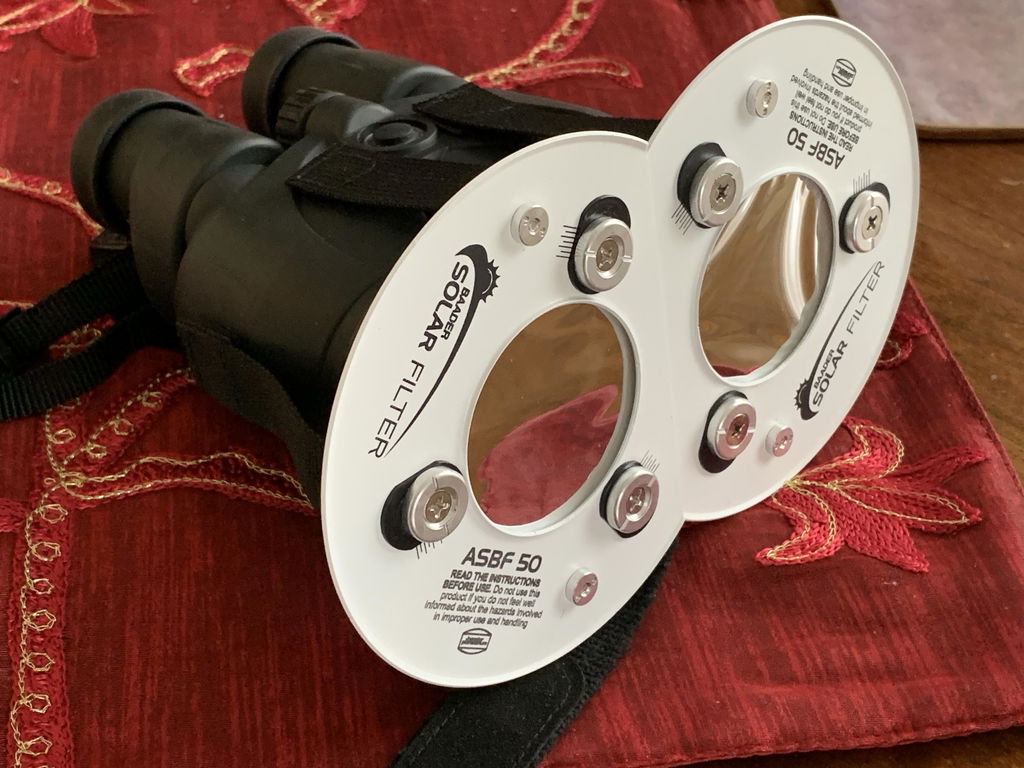
You absolutely must buy two identical filters, one for each objective lens of your binoculars. Using a filter on only one side is extremely dangerous, as your unfiltered eye will still be exposed to the Sun's harmful, focused rays. This product is sold as a single unit, so you will need to add two to your cart.
What will the Sun look like through the Baader AstroSolar Binocular Filter?
The Sun will appear as a sharp, detailed, and neutral-white disk against a black sky. You will be able to clearly see sunspot groups, distinguishing between the darker central umbra and the lighter surrounding penumbra. During periods of good atmospheric seeing, you may also resolve the texture of solar granulation across the surface.
Will the Baader AstroSolar filter film ever need to be replaced?
Yes, the film should be inspected for scratches, pinholes, or damage before every use. If you find any defect that allows concentrated light to pass through, you must discard the filter immediately. With proper care and storage, the film can last for many years, but it is not permanent and its integrity is crucial for your safety.