Skip to content

Language

Country

Baader MaxBright II Binoviewer Set

SKU BAA-2456460
Original price CA$698.00 - Original price CA$859.00
Original price
CA$698.00
CA$698.00 - CA$859.00
Current price CA$698.00
Price Match Policy!
  • Modular design based on the Baader T-2 thread system
  • Optional Glasspath Correctors provide 1.25x, 1.7x, and 2.6x magnification
  • Accommodates both 1.25" and 2" nosepieces for universal telescope compatibility
  • Enables comfortable, fatigue-free viewing with both eyes
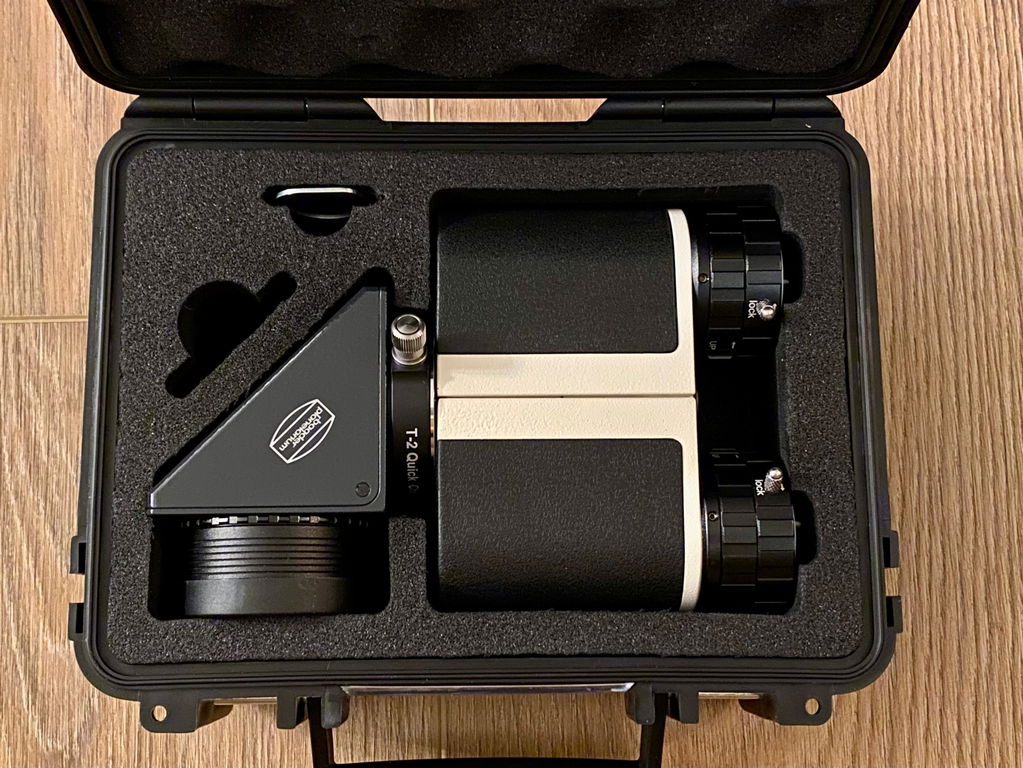
  • Includes T-2 and Zeiss micro-bayonet adapters and a padded carrying case
Backordered
Availability Info
FREE Shipping in Canada
  • Description
  • FAQ
  • Specifications
  • In the Box
  • Downloads
  • Warranty
  • Baader MaxBright II Binoviewer Set

    The Baader MaxBright II Binoviewer Set adapts to nearly any telescope through its modular system of optional 1.25" and 2" nosepieces and native T-2 threads. Available Glasspath Correctors (GPCs) at 1.25x, 1.7x, and 2.6x ensure you can reach focus in refractors, Newtonians, and SCTs while providing multiple magnification steps from a single pair of eyepieces.

    The MaxBright II System: Ergonomics for Two-Eyed Viewing

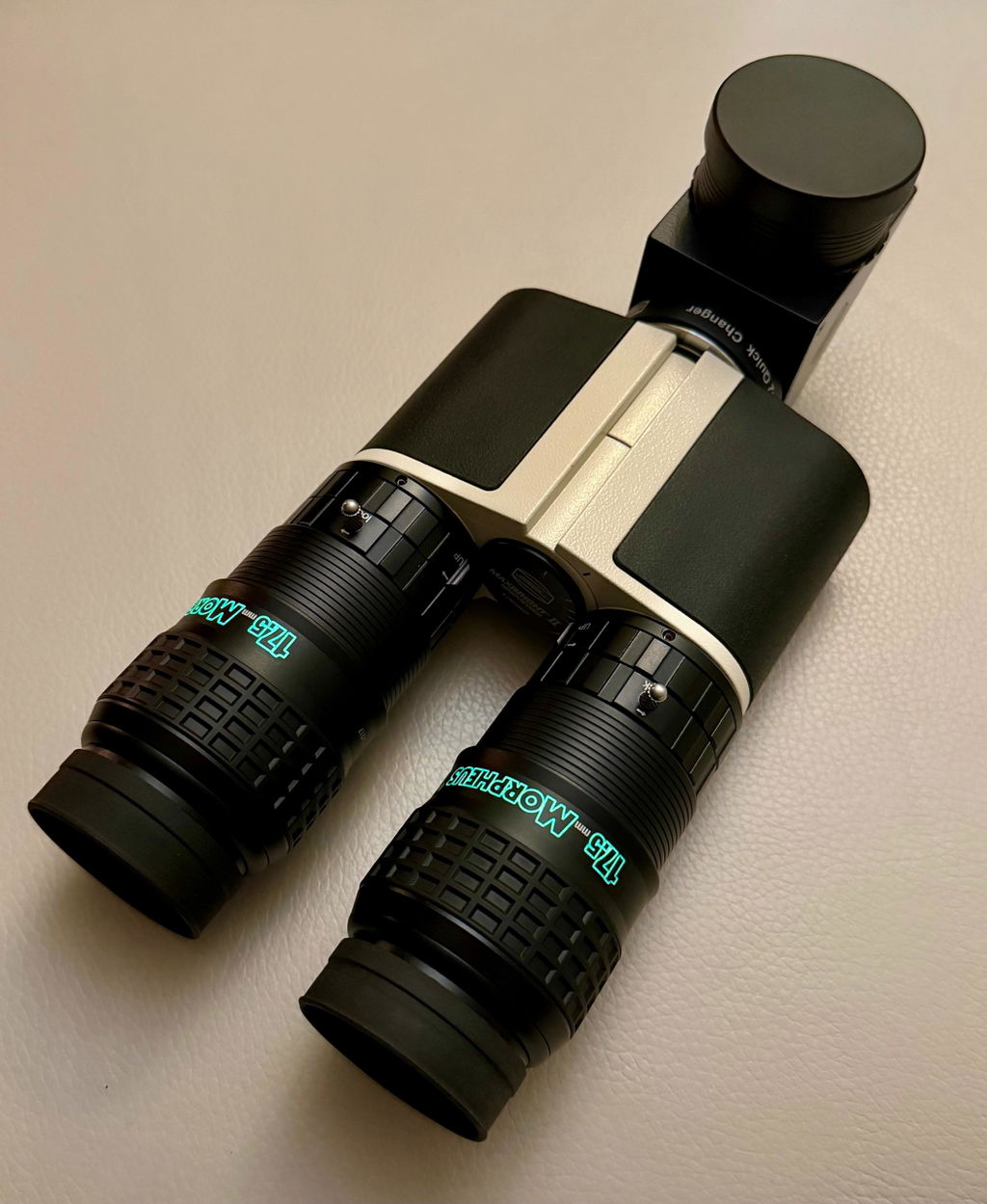
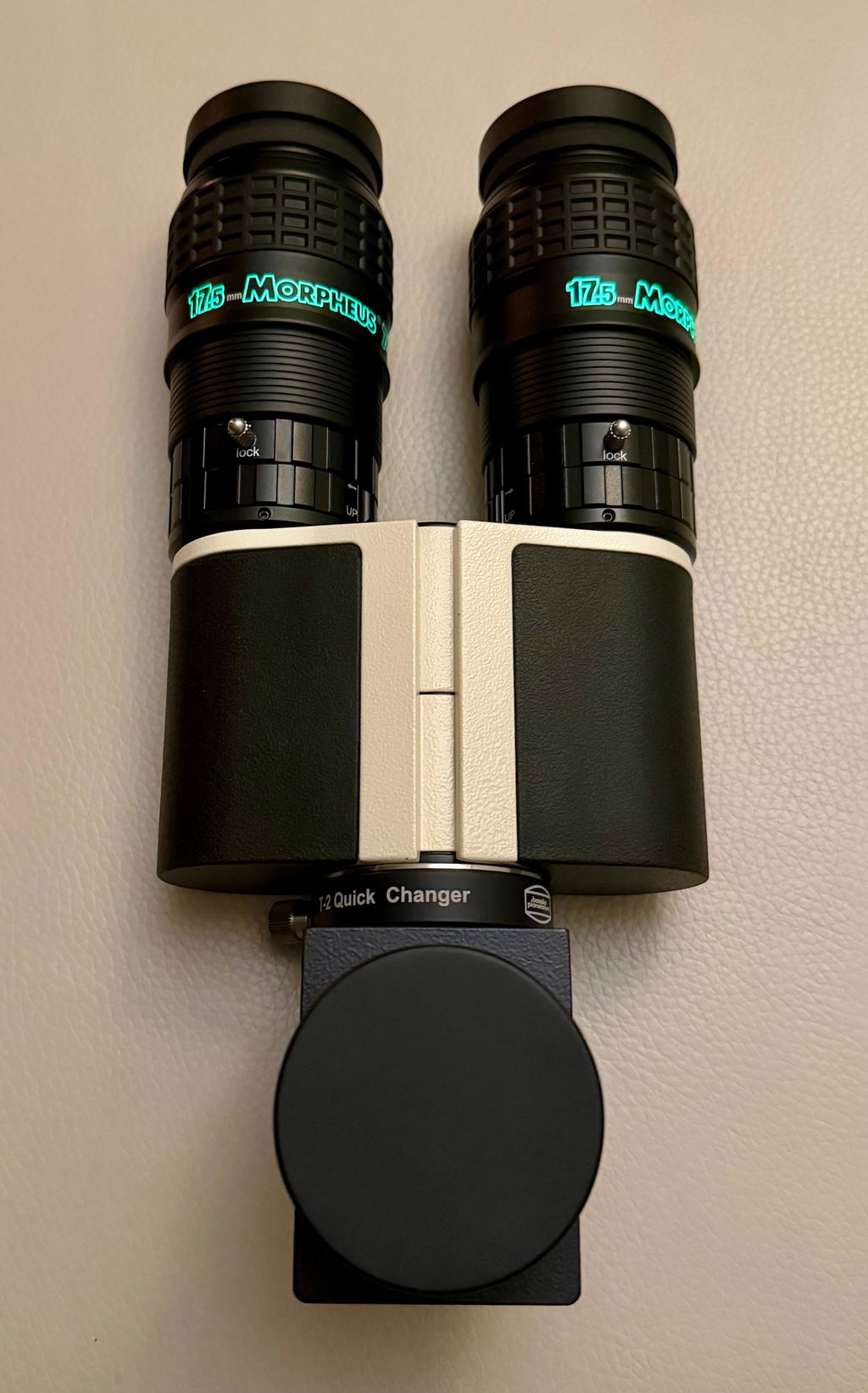
    Viewing celestial objects with both eyes open reduces eye strain, improves comfort during long observing sessions, and can create a more immersive, almost three-dimensional impression on bright targets like the Moon and planets. The MaxBright II is engineered for this experience, featuring click-lock eyepiece holders and smooth diopter adjustment for a perfectly merged image. The binoviewer body is supplied with both T-2 and Zeiss micro-bayonet adapters, ready to integrate into complex visual or imaging trains.

    Reach Focus with 1.25x, 1.7x, & 2.6x Glasspath Correctors

    A binoviewer's prisms add significant length to the light path, which can prevent some telescopes—especially Newtonians—from reaching focus. Baader's Glasspath Correctors (GPCs) are designed to solve this by compensating for the optical path difference. They also act as a high-quality Barlow lens, with available factors of 1.25x, 1.7x, and 2.6x, effectively turning one pair of eyepieces into three different magnifications.

    Universal Connectivity: 1.25", 2", and T-2 System Integration

    The core of the MaxBright II is its native female T-2 thread, making it the central component in Baader's Astro T-2 System. This allows for direct, secure, and perfectly centered connections to a vast range of accessories. Depending on the set purchased, you can attach a standard 1.25" nosepiece, a rigid 2" nosepiece for larger focusers, or thread it directly to other T-2 components like diagonals and filter changers for a completely customized optical train.

    Baader MaxBright II vs. Entry-Level Binoviewers

    While more affordable binoviewers provide a good introduction to two-eyed astronomy, the MaxBright II is built as a long-term, adaptable system. Here are the key distinctions:

    • System Modularity: Entry-level models typically have a fixed 1.25" nosepiece. The MaxBright II's T-2 thread system allows it to connect to virtually any focuser or accessory, providing a more rigid and versatile connection that can adapt as your equipment changes.
    • Optical Correction: The Baader GPCs are engineered specifically for the MaxBright II to correct the optical path with minimal degradation. This is a critical advantage for achieving focus in "fast" optical systems like Newtonian reflectors, where entry-level units often struggle.
    • Trade-Offs: The MaxBright II system represents a greater initial investment, and like all binoviewers, requires you to purchase two identical eyepieces. It also adds weight and length compared to a single eyepiece, which must be considered for mount balancing.
  • What is the main benefit of the Baader MaxBright II over a single eyepiece?

    The primary benefit is observing comfort. Using both eyes reduces strain and fatigue, allowing you to observe for longer periods. Many observers also report a more natural, immersive, or even "3D-like" view on bright, detailed objects like the Moon, Jupiter, Saturn, and bright globular clusters.

    Do I need a Glasspath Corrector (GPC) for my Baader MaxBright II?

    It depends on your telescope. Newtonian reflectors almost always require a GPC to reach focus. Refractors and Schmidt-Cassegrains (SCTs) often have enough focuser travel to work without one, but a GPC can still be useful for adding magnification options.

    How do the different GPCs (1.25x, 1.7x, 2.6x) for the MaxBright II change my view?

    The GPCs act like a Barlow lens, increasing magnification. With one pair of 25mm eyepieces, for example, you can achieve three distinct magnifications:

    • 1.25x GPC: Provides a modest power increase, ideal for wide-field scanning.
    • 1.7x GPC: A great general-purpose increase for framing most deep-sky objects.
    • 2.6x GPC: Delivers high magnification suitable for detailed planetary, lunar, and double-star observation.

    How can I use the Baader MaxBright II with my 8" f/5 Newtonian reflector?

    For an 8" f/5 Newtonian, you will absolutely need a Glasspath Corrector to reach focus. The 1.7x GPC is an excellent starting point, as it provides enough inward focus correction for most Newtonians. You will also need a 2" nosepiece to fit your telescope's focuser. The combination of the MaxBright II, the 1.7x GPC, and a 2" nosepiece will create a robust setup for your reflector.

    What eyepieces work best with the Baader MaxBright II for viewing Jupiter or the Moon?

    For high-resolution planetary and lunar viewing with the Baader MaxBright II, you need two identical, high-quality eyepieces. Plössl or Orthoscopic designs in the 9mm to 15mm range are excellent choices. When combined with the 1.7x or 2.6x GPC, this focal length range will provide the high magnifications needed to resolve cloud bands on Jupiter or fine crater details on the Moon.

    Can I use 2" eyepieces with the Baader MaxBright II Binoviewer?

    No. The Baader MaxBright II, like nearly all astronomical binoviewers, is designed to accept 1.25" eyepieces only. The internal prisms and mechanics do not have a large enough clear aperture to accommodate the wider field stops of 2" eyepieces.

  • Available Configurations Binoviewer only, Binoviewer w/ 1.25" nosepiece, Binoviewer w/ 2" nosepiece, Binoviewer w/ 1:1.25 GPC and 1.25" nosepiece, Binoviewer w/ 1:1.7 GPC and 1.25" nosepiece, Binoviewer w/ 1:2.65 GPC and 1.25" nosepiece, Binoviewer w/ 1:1.25 GPC and 2" nosepiece, Binoviewer w/ 1:1.7 GPC and 2" nosepiece, Binoviewer w/ 1:2.65 GPC and 2" nosepiece
    Net weight (kg) 1.28 (Binoviewer w/ 1.25" nosepiece)
    1.32 (Binoviewer w/ 2" nosepiece)
    1.30 (Binoviewer w/ 1:1.25 GPC and 1.25" nosepiece)
    1.33 (Binoviewer w/ 1:1.7 GPC and 1.25" nosepiece, Binoviewer w/ 1:2.65 GPC and 1.25" nosepiece, Binoviewer w/ 1:1.25 GPC and 2" nosepiece, Binoviewer w/ 1:1.7 GPC and 2" nosepiece, Binoviewer w/ 1:1.2.65 GPC and 2" nosepiece)
  • Baader Planetarium Warranty Policy