
Skip to content

Language

Country

Baader Polarizing Filter - Single

SKU BAA-2408343
Original price CA$62.00 - Original price CA$105.00
Original price
CA$62.00
CA$62.00 - CA$105.00
Current price CA$62.00
Price Match Policy!
  • Available in 1.25" and 2" Barrel Sizes
  • Essential for Brightness Control with a Herschel Wedge
  • Enhances Contrast on Planetary and Lunar Targets
  • Stackable Design for Variable Light Attenuation
Backordered
Availability Info
Qualifies for FREE Shipping in Canada on orders over $500.
  • Description
  • FAQ
  • Specifications
  • In the Box
  • Downloads
  • Warranty
  • Baader Single Polarizing Filter

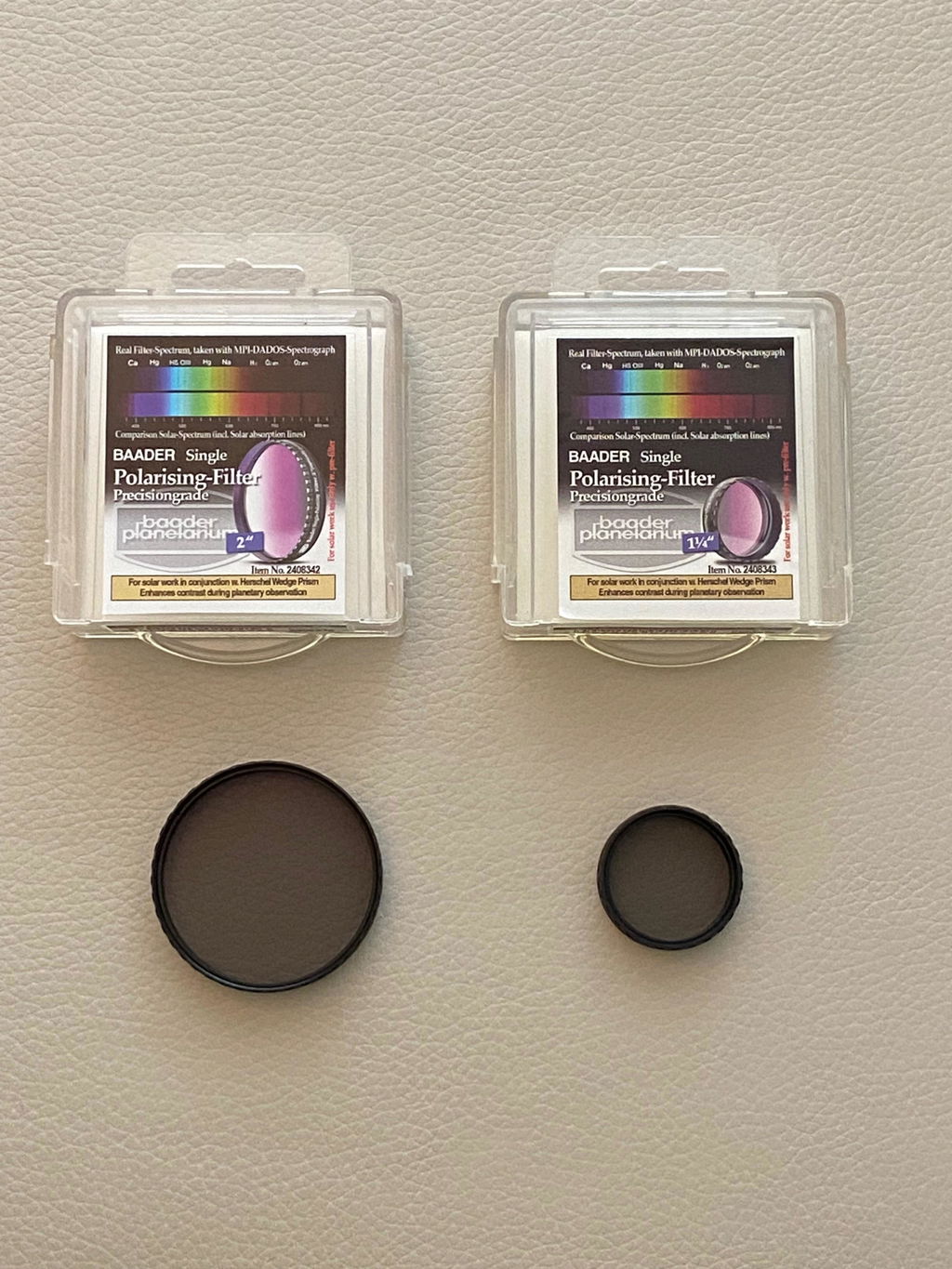
    Available in 1.25" and 2" formats, the Baader Single Polarizing Filter is a specialized tool for managing image brightness in critical applications. Its primary function is to fine-tune the dazzling solar image produced by a Baader Herschel Wedge, and it can be paired with a second filter to create a variable attenuator for comfortable lunar and planetary observation.

    Solar Observation: The Primary Role with a Baader Herschel Wedge

    For white-light solar observing, a single Baader Polarizing Filter is the perfect companion to a Herschel Safety Wedge. The wedge itself acts as a linear polarizer, meaning the light exiting it is already polarized. By simply rotating this single filter in your eyepiece barrel or diagonal, you can smoothly adjust the final image brightness to your preference without altering color or contrast.

    Crucial Safety Warning: A polarizing filter must never be used for solar observation on its own. It must always be placed behind a primary solar filter, such as a Baader AstroSolar front-mounted film filter or a Herschel Safety Wedge. Using an eyepiece filter alone will result in immediate and permanent eye damage.

    Lunar & Planetary Viewing: Variable Attenuation and Contrast

    On its own, a single polarizing filter can subtly increase contrast when viewing planets, helping to define faint cloud belts on Jupiter or surface details on Mars. Its real strength for night observing comes from using two filters together. By threading a second Baader Single Polarizing Filter into the first, you create a variable neutral density filter.

    As you rotate one filter relative to the other, you can dial in the exact amount of brightness reduction needed to view the full Moon without glare or to tease out faint details near the terminator. This provides a level of control that fixed neutral density filters cannot match.

    Optical Considerations: Flexibility vs. Image Purity

    The Baader Polarizing Filter is designed for maximum flexibility. However, it's important to understand the optical trade-offs. For variable brightness control, you can stack two single filters or use Baader's dedicated Double Polarizing Filter, which integrates both rotating elements into a single, convenient housing.

    If your goal is the absolute highest image fidelity with minimal light scatter, a fixed-transmission Neutral Density (ND) filter is optically superior. ND filters introduce fewer glass-to-air surfaces into the light path, which maximizes contrast and image purity. For observers who prioritize convenience and adjustability, the polarizing filter system is ideal; for those seeking ultimate image quality at a fixed brightness, an ND filter is the better choice.

  • Why do I only need one Baader Polarizing Filter for my Herschel Wedge?

    The Baader Herschel Safety Wedge internally polarizes the sunlight it transmits. Because the light is already polarized, a single polarizing filter threaded onto your eyepiece is sufficient to act as a dimmer switch—simply rotating it will adjust the final image brightness.

    How do I adjust brightness on the Moon with a Baader Single Polarizing Filter?

    To adjust brightness on the Moon or planets, you need two single polarizing filters. Thread one onto your eyepiece, and then thread the second one into the first. By rotating the eyepiece, you change the alignment of the filters, allowing you to vary the light transmission from maximum to nearly fully blocked.

    Can I use the Baader Polarizing Filter for solar viewing by itself?

    Absolutely not. A polarizing filter alone provides nowhere near the protection required for safe solar viewing. It must only be used downstream from a primary, objective-side solar filter like Baader AstroSolar film or a Herschel Safety Wedge. Using it alone will cause instant and irreversible blindness.

    Is a Baader Polarizing Filter better than a Neutral Density (ND) filter?

    It depends on your goal. A polarizing filter system offers flexibility to adjust brightness, which is excellent for changing conditions or targets. For the absolute highest image quality, a fixed Neutral Density filter is superior because it has fewer optical surfaces, resulting in less scatter and higher contrast.

    What is the difference between buying two Baader single filters and the Baader Double Polarizing Filter?

    Functionally, they achieve the same result. Buying two single filters gives you more modularity—you can use just one for planetary contrast or with a Herschel wedge. The dedicated Baader Double Polarizing Filter integrates both filters into a single, rotating cell, which is often more convenient to use as a dedicated lunar or planetary filter.

    Will the Baader Polarizing Filter thread into my standard eyepieces?

    Yes. The Baader Polarizing Filters are available in 1.25" and 2" sizes and feature standard filter threads (M28.5x0.6 for 1.25" and M48x0.75 for 2") that are compatible with the vast majority of astronomical eyepieces and accessories.

  • Available Sizes 1.25" Round Mounted, 2" Round Mounted
    Net weight (kg) 0.01
    Single or Set? Single Filter
    Filter mounted Double mounted (LPFC 6mm) - total height 15mm
    Filter Usage Lunar, Planetary, Solar, Specialty
    Type of Filter Neutral Density, Polarizing
    Filter Thickness (without cell) 2 mm
    Transmission Range full Spectrum
    AR-Coating Phantom Coating® Group, planeoptically polished
  • Baader Planetarium Warranty