Skip to content

Language

Country

QHYCCD miniCAM8 Mono Camera

by QHYCCD
SKU QHY-120022
Original price CA$859.00 - Original price CA$1,258.00
Original price
CA$1,142.00
CA$859.00 - CA$1,258.00
Current price CA$1,142.00
Price Match Policy!
  • Monochrome Sony IMX585 Sensor
  • 3856 x 2180 (8 MP) Resolution
  • 2.9 µm Pixel Size
  • Built-in 8-Position Filter Wheel
  • -45°C Thermoelectric Cooling
  • 512 MB DDR3 Buffer Memory
  • 12-bit ADC with 16-bit Output
  • 92% Peak Quantum Efficiency
Backordered
Availability Info
FREE Shipping in Canada
Framing Simulator
Framing SimulatorInstant FOV Preview

Preview your camera's FOV

See exactly how your targets fit with the QHYCCD miniCAM8 Mono Camera, on real sky survey data.

Launch Imaging Assistant
Vignetting Calculator

Will your imaging train vignette?

Check which filter and adapter sizes clear the sensor with the QHYCCD miniCAM8 Mono Camera, and how much light the corners lose.

Check vignetting
  • Description
  • FAQ
  • Specifications
  • In the Box
  • Downloads
  • Warranty
  • QHYCCD miniCAM8 Mono Camera

    The QHYCCD miniCAM8 Mono Camera integrates an 8-megapixel Sony IMX585 sensor with a built-in 8-position filter wheel and two-stage thermoelectric cooling into a single compact unit. Its 2.9 µm pixels and 3856 x 2180 resolution serve both deep-space and high-resolution planetary imaging, supported by a peak Quantum Efficiency of 92%. The camera achieves a cooling delta of 45°C below ambient to control thermal noise, while the 512 MB DDR3 buffer ensures stable data transfer at up to 41.5 frames per second.

    Sony IMX585: 8MP Resolution and 2.9µm Pixels

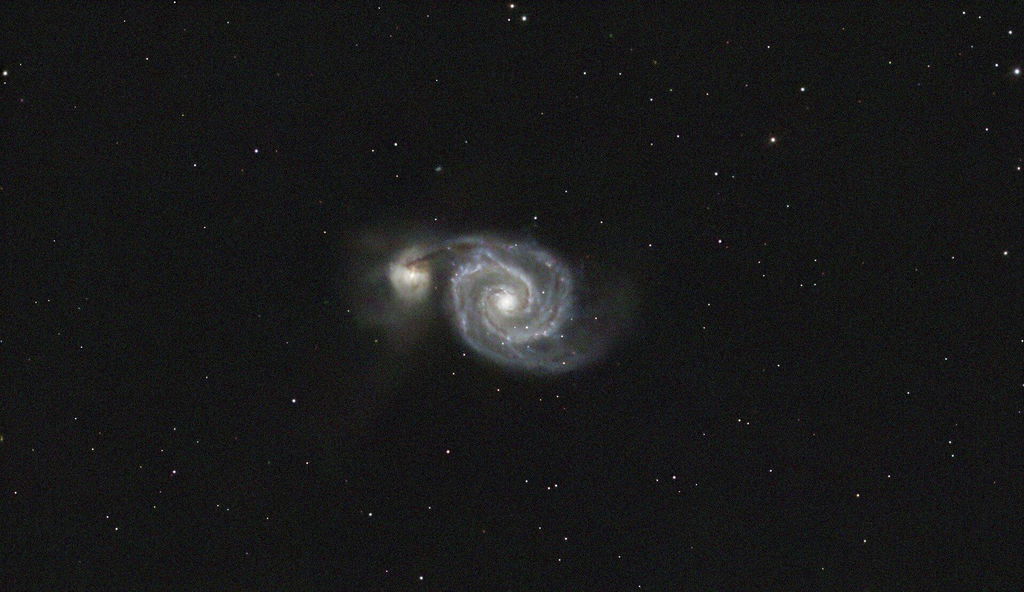
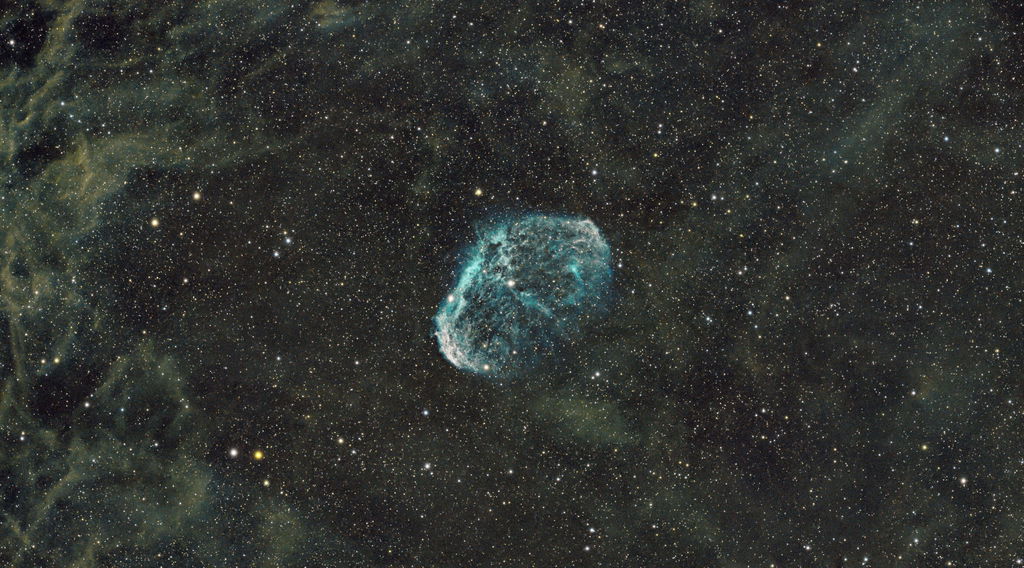
    At the core of the miniCAM8 is the Sony IMX585, a back-illuminated monochrome sensor with a 3856 x 2180 pixel array. The 2.9 µm pixels give fine sampling, and the 12.85 mm diagonal suits smaller galaxies, planetary nebulae and the planets.

    As a back-illuminated (BSI) sensor, the IMX585's wiring layer is positioned behind the photosensitive area, which prevents obstruction of incoming light. Peak Quantum Efficiency (QE) is 92%. The IMX585 is a Sony Starvis II sensor with high sensitivity and HDR, and near-infrared sensitivity about 1.7 times that of the IMX485.

    Built-In 8-Position Filter Wheel with 3nm or 7nm Options

    The miniCAM8 eliminates the need for an external filter wheel by integrating an 8-position carousel directly into the camera body. This keeps the imaging train short and compact. The wheel holds custom 19 x 12 x 1.1 mm filters, and this package includes a complete set for full-color and narrowband imaging.

    Depending on the bundle, you receive a full suite of seven filters to populate the wheel. Both bundles include LRGB filters for broadband color imaging. The key difference lies in the narrowband filters for capturing specific emission lines from nebulae.

    • DeepSky Combo: Includes LRGB filters plus a 7nm SHO filter set (Hydrogen-alpha, Oxygen-III, and Sulphur-II).
    • Deep Sky Combo EVO: Includes LRGB filters plus a 3nm SHO filter set. The narrower 3nm bandpass passes less background light around each emission line.

    15.5 Stops and 0.76e- Read Noise with Linearity HDR Mode

    While the IMX585 sensor has a native 12-bit ADC, QHYCCD implements a Linearity HDR Mode that merges high and low gain exposures to produce a 16-bit data output. Dynamic range reaches up to 46,300:1 (93 dB, 15.5 stops) in this mode. In this mode, the read noise is just 1.0e- with a full well capacity of 46 ke-.

    For planetary or other high-frame-rate applications, the standard mode delivers an even lower minimum read noise of 0.76e- and a larger full well of 54 ke-. The miniCAM8 is a zero amplifier glow camera.

    -45°C TEC Cooling with Integrated Dew Heater

    The miniCAM8 features a regulated two-stage thermoelectric cooling (TEC) system capable of reducing the sensor temperature to 45°C below ambient. Regulated cooling keeps thermal noise low in long deep-sky exposures and lets you match dark frames to a set temperature.

    To combat condensation during cooling, QHYCCD has implemented a comprehensive anti-dew system. An electric dew heater is built into the optical window to prevent frost or dew from forming on the exterior glass. Inside, QHYCCD now ships the camera with drying tablets pre-placed in the chamber, and a drying port on the side of the front end accepts a drying tube if moisture ever fogs the sensor glass (turn off cooling first).

    41.5 FPS Capture with a 512MB DDR3 Buffer

    For planetary imaging, the miniCAM8 uses its USB 3.0 interface to deliver a maximum frame rate of 41.5 FPS at full 3856 x 2180 resolution in 8-bit mode. When capturing the higher dynamic range of 16-bit data, the rate is a stable 23.5 FPS. These rates support "lucky imaging" of the planets.

    To prevent dropped frames during high-speed capture, the camera is equipped with a 512 MB DDR3 image buffer. This onboard memory holds frames while the computer is busy.

    17.5mm Back Focus and 480g Compact Body

    The miniCAM8 has a 17.5 mm back focus. The camera includes both 1.25-inch and 2-inch nosepieces for direct connection to a focuser, and its front threads also support C-mount lenses with a thread length under 3.5mm.

    Weighing only 480 g, the camera is light. For guiding, a dedicated QHYCCD Off-Axis Guider (sold separately) is available for the miniCAM8, which uses a large 14x10mm prism to maximize light to the guide camera while maintaining a standard 55mm back focus for common correctors.

    92% Peak QE: IMX585 vs. IMX571 Performance

    The miniCAM8 has a peak Quantum Efficiency of 92%, and measured QE at the main astronomical lines has been published.

    In QHYCCD's comparison with the IMX571 (which QHYCCD treats as representative of mainstream cooled cameras), the IMX585 curve is higher at these wavelengths.

    • OIII (500nm): The miniCAM8 achieves 91.2% QE.
    • H-alpha (656nm): With 80.9% QE in this critical band.
    • SII (672nm): At 78.7% QE.
  • What is the main advantage of the QHYCCD miniCAM8's integrated design?

    The primary advantage is the all-in-one integration of the camera, a regulated TEC cooler, and an 8-position filter wheel. This removes the need for a separate filter wheel and keeps the setup compact at 480 g.

    How does the miniCAM8 Mono perform on planets like Saturn?

    The miniCAM8 is designed for high-resolution planetary images as well as deep-sky work. Its 2.9 µm pixels provide high-resolution sampling, and the ability to capture at 41.5 FPS (8-bit) allows you to use lucky imaging techniques to overcome atmospheric turbulence. The monochrome sensor's high sensitivity, especially its 40.1% QE in the 889nm methane band, suits methane-band imaging of Jupiter and Saturn.

    What is Linearity HDR Mode on the miniCAM8 and when should I use it?

    Linearity HDR Mode is a QHYCCD feature that combines high and low gain readouts from the sensor to create a 16-bit image with expanded dynamic range (15.5 stops). You should use this mode for deep-sky objects with a bright core and faint outer regions, such as the Orion Nebula (M42).

    Should I choose the 3nm or 7nm filter set for the miniCAM8?

    The choice depends on your observing location. 7nm filters (DeepSky Combo) pass a wider band around each line. 3nm filters (Deep Sky Combo EVO) pass a narrower band, so less background light reaches the sensor.

    Does the miniCAM8 require an external power supply?

    Yes. The miniCAM8 needs a 12V DC supply (11V to 13.8V). QHYCCD's setup guide says to connect the 12V power first and then the USB 3.0 cable, otherwise the camera will not be recognized.

    What software do I need to use the QHYCCD miniCAM8?

    You will need to install the QHYCCD All-In-One Pack, which includes system drivers, ASCOM drivers, and SDKs for third-party software. QHYCCD's guide covers N.I.N.A. (QHY plugin or ASCOM), SharpCap and its own EZCAP_Qt.

  • Sensor Sony IMX585
    Color or mono Monochrome
    Resolution 3856 x 2180
    Pixel size 2.9 µm
    Sensor width 11.18 mm
    Sensor height 6.32 mm
    Sensor diagonal 12.85 mm
    ADC 12-bit
    Full well 54 ke-
    Read noise (min-max) 0.76-7.8 e-
    Peak QE 92 %
    Shutter Rolling
    Cooled Yes (TEC)
    Cooling delta T 45°C below ambient
    Buffer memory 512 MB
    Interface / control USB3.0
    Max frame rate at full resolution 41.5 fps @ 8-bit, 23.5 fps @ 16-bit
    Back focus 17.5 mm
    Front connection 1.25in and 2in nosepieces; C-mount lenses (lens thread under 3.5mm)
    Protective window AR+AR
    Power requirement 12V DC (11V to 13.8V)
    Weight 480 g
    • miniCAM8M camera

      × 1

    • Filter disc

      × 1

    • Tweezers

      × 1

    • LRGB + 7nm SHO filter set, 7 filters (DeepSky Combo)

      × 1

    • LRGB + 3nm SHO filter set, 7 filters (Deep Sky Combo EVO)

      × 1

  • QHYCCD Warranty